Tag: culture

  • Study: Libraries serve Indigenous children and adults alike

    A recent study found that adults in isolated, Indigenous communities use libraries as much as children do, sometimes more. The 2025 study looked at the long-term impact of Indigenous-led libraries installed in partnership with Write to Read BC.

    This research was made possible with Simon Fraser University’s CERi funding. The study’s Indigenous researcher gathered data from isolated communities that installed an indigenous-led library with us.

    School libraries

    Many communities installed a library connected to their local school. Obviously, these spaces get significant use by children.

    However, adults also want to use reading materials and programs about culture and language. That’s why some schools welcome adults, too. For example, Nisaika Kumtuks school in Nanaimo set specific hours for family members to use material in its library.

    Rather than in a school, many communities installed books and computers a separate community facility. Both children and adults can use these, but they are harder to fund, according to some study participants. “There is funding for libraries attached to schools, but not necessarily for community-specific libraries,” the study’s author reports.

    Nevertheless, over the past 15 years most libraries installed with Write to Read BC are community libraries.

    Community libraries

    In addition to support for reading—including reading about Indigenous cultures and languages—these spaces are also community-building hubs. This is one of the benefits that attracts community members. Often, libraries are a showcase of local culture and history. One participant mentioned plans to create a museum alongside the library.

    In addition to these adult-oriented activities, community libraries also help educate children. Since 20% of the youth living on reserves attend school online, community libraries often have a role in childhood education.

    Unfortunately, older libraries in the Write to Read BC program did not all include computers and high-speed Internet. Some participants told the researcher that “a designated space” for online learners would be “a helpful addition to their community.” This would benefit adults and children alike.

    Findings from the CERi study were first presented in October, 2025.
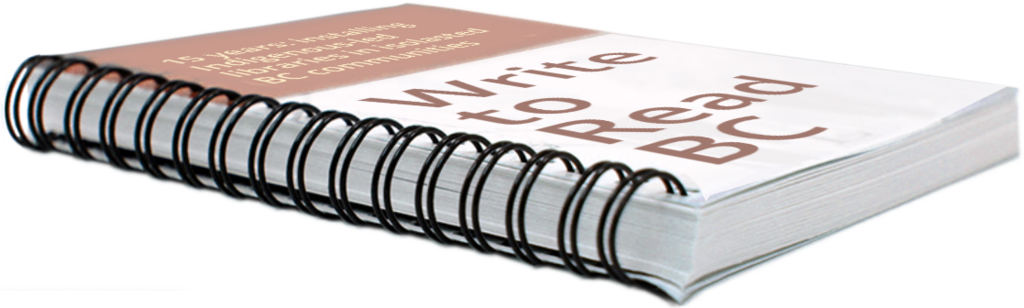
    Research on the impact of Indigenous-led libraries installed together with Write to Read BC in isolated BC communities.
  • Value in isolated libraries: SFU study

    Researcher and Simon Fraser University (SFU) graduate Jody Bauche recently spoke about 15 years of Write to Read BC projects. These projects are partnerships with Indigenous communities, to design and install the library they want. Bauche’s research findings suggest that isolated indigenous communities across BC gain substantially. The gains show up in several ways.

    Firstly, at a community-wide level libraries are places where people connect, according to Bauche. She found that Write to Read BC libraries foster resiliency and active community participation. The libraries are used as community hubs.

    Secondly, individual or “autonomous” library use is also connected to increased productivity within communities.

    Thirdly, the effect on literacy is positive. Bauche found an increased interest in literacy related to community libraries installed by Write to Read BC.

    Lastly, Bauche noted several community challenges indirectly related to libraries. For example, due to shifts in literacy funding, schools have been absorbing community-based programs. Also, expanding those community programs increases the demand for meeting space. A community library can ease the demands on schools and provide another place to host programs.

    Full details of the findings will be available when Bauche publishes her complete study, later this year. The study, which Write to Read BC requested, received funding from SFU Community-Engaged Research Initiative, or SFU CERi. This program helps community organisations understand the effectiveness of their efforts. During this research, Bauche applied her cultural insight as a First Nation member. And as a graduate of SFU’s Communication, Art and Technology faculty, she also brought her academic training.

    As for the findings, Bauche shared them first with Write to Read BC leaders and the Rotary Club of Steveston-Richmond. That’s because the Rotary Club is a significant funder of the Indigenous-led libraries that Write to Read BC volunteers install. Over the past 15 years, these partnerships have resulted in about two dozen libraries in isolated communities across BC.

    About Jody Bauche

    For about 2 decades after completing a 2005 degree in social work, Jody Bauche worked as an Indigenous social worker. More recently, she enrolled in SFU’s new program, Communication Research for Social Change. In this program. Bauche was among the first to graduate. She earned a Master of Arts in Communication with a project about supporting Indigenous sovereign and cultural production.

    In a mid-2025 interview about the Social Change program, Bauche spoke with SFU staff writer, Andrew Ringer. Bauche told Ringer that her work toward a master degree will help her ability to lobby government. It also helps her frame things in a way that inspires others to get on board with social change. Bauche said communication, art, and technology will help Indigenous people retain and develop their cultural knowledge. Bauche told Ringer that social change is non-partisan because everybody benefits.

    In addition to her research work, Bauche teaches communication in an Indigenous context at Royal Roads University. She also teaches social work at Camosun College.

    Research on the impact of Indigenous-led libraries installed together with Write to Read BC in isolated BC communities.
  • Promoting Write to Read BC with BCLA librarians

    Today, Write to Read BC announced the launch of this updated website to members of BC Library Association, or BCLA. That’s because BCLA members are well placed to promote the Write to Read BC project. The announcement also mentions an upcoming impact study about communities that have an indigenous-led library.

    BC Library Association logo.

    The role of librarians

    Librarians focus on advocacy, professional development, and support of intellectual freedom. BCLA members work to ensure everyone has equitable access to information, ideas, and works of the imagination. In contrast, Write to Read BC does the same by following the lead of First Nations communities.

    The announcement to BCLA

    This is what today’s announcement covered:

    On this National Day for Truth and Reconciliation it’s fitting to announce two things about the long-lasting Write to Read BC project.

    1. There is a new website, writetoreadbc.org.
    2. An impact study is in its final stages, with a report scheduled to be released in November.

    As many of you know, former lieutenant-governor of BC Steven Point envisioned and initiated this project during his time in that role between 2007 and 2012. A key partner in making the project a reality was his aide-de-camp at the time, Bob Blacker, an active member of a Rotary Club. CBC carried a story about this joint effort in May of 2014, as did various newspapers.

    Fast forward and along the way to 2025, Write to Read BC has collaborated with numerous Indigenous communities, under their leadership, to plan and install highly local libraries and learning centres. The new website documents these multiple efforts going back to 2011.

    Funding and support for the new website and the impact report was generously provided by SFU’s Main Street Research Shop. It collaborates with community partners, students, and faculty members to address community questions and concerns through research. The SFU Indigenous Student Centre has been equally generous in contributing in-kind support for a portion of the work schedule to co-supervise both the research and the web development.

  • Capilano Little Ones gets library

    One of Squamish Nation’s urban schools, Capilano Littlest Ones Xwemelch’stn School, celebrated its new library in November 2022. The school is on Squamish land in Greater Vancouver.

    The school brings together 130 Indigenous and non-Indigenous students in the Norgate area of urban North Vancouver. The school and its library help break down social barriers, build bridges across cultures, and re-establish positive relationships. Capilano Littlest Ones is a community school under the auspices of North Vancouver School District.

  • Guest speaker at BC Library Association

    Write to Read BC volunteer Margaret Fletcher will speak to the Community-Led interest group of BC Library Association, or BCLA. Fletcher will discuss how Write to Read BC partners on projects in isolated communities across BC. She’ll also talk about the impact these projects have on social barriers and reinforcing community culture. This includes the installation of Internet-connected computers that provide remote access to courses and conferences through these learning centres.

    The association’s interest group meets quarterly, with its next meeting in December.

    BC Library Association logo.

    The BCLA Community-Led interest group is about a community-led service approach, which consists of community consultation, needs assessments, metrics, and ongoing monitoring of services and programs. The interest group’s members want to connect and collaborate with community members to better support their needs.

    At its core, the community-led model is about reducing or eliminating barriers to library services and programs. Another key factor to the community-led approach is staff training and development within the communities.

  • Usborn funding for books

    Usborne Books at Home is funding $1,000 each for Write to Read BC’s current library projects. A discussion over the summer led to Usborne’s support for the libraries of Gitsegukla, Tsideldel, and Heiltsuk first nations.

    With each $1,000 order, Usborne will also provide free shipping and a 25% credit for additional purchases. This helps Write to Read BC make cash donations go even further. Our volunteer team thanks Usborne and its local representative, Louise Toews, for their generosity.

    Logo for Usborne Books At Home Canada.

    Write to read BC volunteer Wendy Brundage visited Gitsegukla in early September, and will follow up with the Elementary School’s principal Louise Ormerod to consult on the school’s book choices.

    Usborne is based in southern Ontario, and has been in business for over 50 years. It’s a past winner of Children’s Book Publisher of the Year. Its mission is to help spread a love of literacy to kids and their families across Canada.

  • Thomas Kero mural

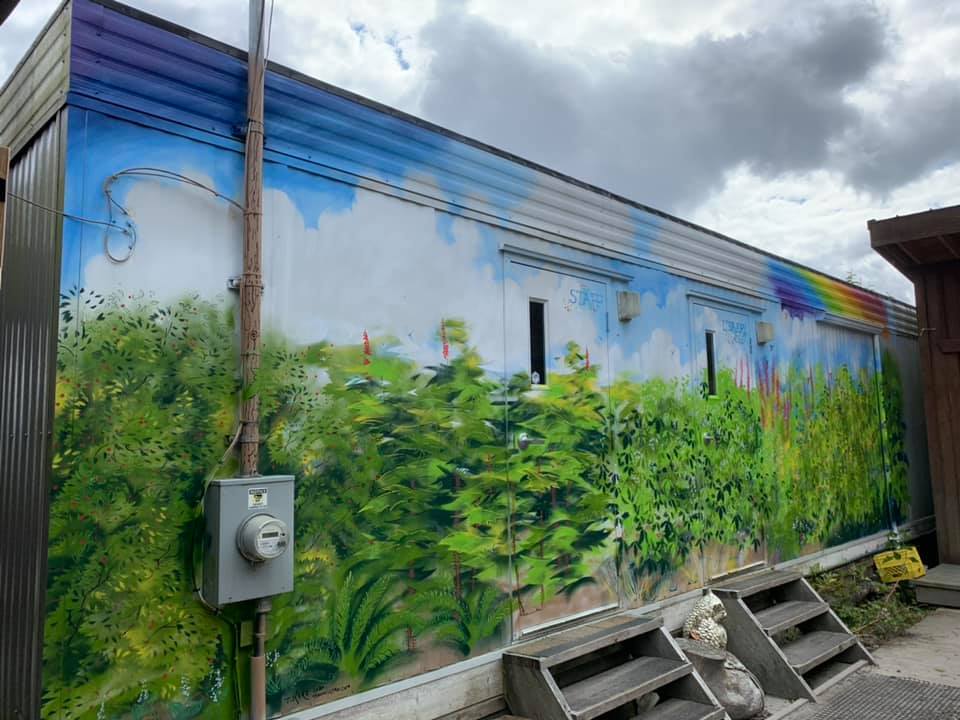
    Need to brighten up your cloudy day? Stop by our Bella Bella library/office and check out this beautiful new mural by Thomas Kero! Photos don’t do it justice. There are so many hidden creatures and special features nestled into the summertime foliage. 

    Thomas Kero mural.
    A mural painted on the Bella Bella library. Kero wants the town to be as beautiful as the surrounding landscape.
  • Planning Klemtu library, cultural centre

    Klemtu, BC, an indigenous community in BC’s coastal fjords, has asked to partner with Write to Read BC to work towards a library and cultural centre.

    For this project, Write to Read BC has also partnered with the Rotary Club of Saanich.

    Our design response team has been invited to the community to meet and start planning the facility with them. Hoping to join us in the first meeting are Brenda Rothwell, Success By 6 coordinator for the area, Steven Point, lieutenant-governor of BC, and members of the Rotary Club of Saanich.

  • Nuu-Chah-Nulth council

    About the organisation

    The Nuu-chah-nulth is a First Nations tribal council, on the west coast of Vancouver Island, near Port Alberni, BC. These tribes share many aspects of their language and cultural traditions.

    About the library

    Community members reached out to Write to Read BC to discuss installing an Indigenous-led library in the Port Alberni area.

  • Digital diary project in Ditidaht

    On a recent visit to Ditidaht, one Write to Read BC volunteer brought along a digital camera rto donate to the school. He described the camera as “an old Panasonic Lumix SLR” but adds: “It’s amazing what can be accomplished using digital technology. Computers and digital cameras have changed the world in which we live. Pretty soon everybody will be a movie maker.”

    That includes the 10 high school students at Ditidaht’s community school.

    The Lumix camera has a 24× zoom, a Leica glass lens, built-in image stabilization to reduce motion blur, and a memory card. It shoots great photos. It was given to the teacher for use by the high school students.

    Students to make a digital diary

    From January to June 2014, high school students will use the camera to take photos of their daily life: going to school, playing, at home, with friends, in the community. Students can also take photos in the woods and on the water.

    The camera’s memory card can store thousands of images, and the students are encouraged to photograph everything they see. Their teacher, Eva Clarke, will select the best images and store them on a computer.

    The learning objectives of this project are to:

    • learn digital photography.
    • learn to see and document village life.
    • self-publish a book—perhaps an e-book.

    A digital diary that shows what life is like in the Ditidaht village can introduce people to a place few will ever get to visit in person. By using a camera, connecting people from elsewhere to an isolated community like Ditidaht is as easy as point and shoot.

    The project runs from January to June, 2014.

    Eva Clarke, a Ditidaht school teacher.
    Ditidaht teacher Eva Clarke will choose the best images that students take of their life in and around the village.