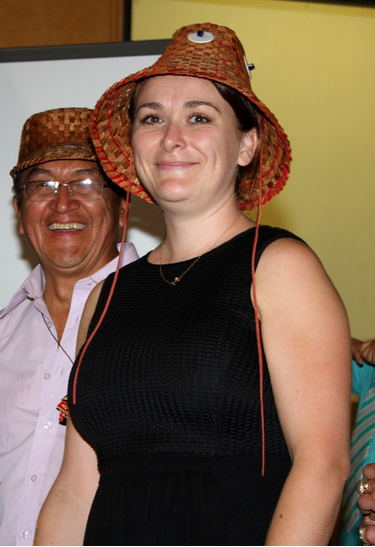
On 27 May 2014, CBC reported six new libraries have been installed in isolated, Indigenous communities across BC. Each new library adds to the 200 First Nations that already have a library.
CBC credits Write to Read BC, along with Bob Blacker and former lieutenant-governor of BC, Steven Point.
At its start, the project recruited retired librarians to solicit book donations. Write to Read BC soon had over 30,000 new and used books to assess and catalogue from their headquarters in a donated storage locker.
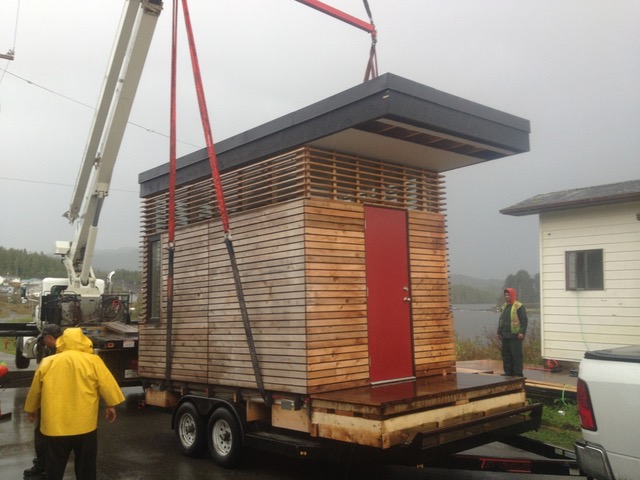
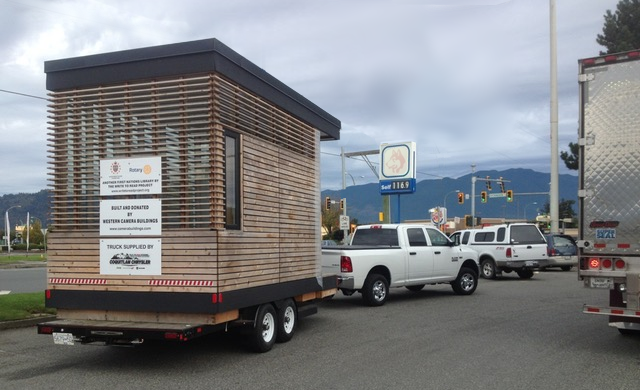
Metlakatla, just north of Prince Rupert, recently welcomed a small, portable library. The entire building was placed on a trailer and then transported from BC’s Lower Mainland by ferry, to serve Metlakatla.
The first step: loading the library onto the ferry.
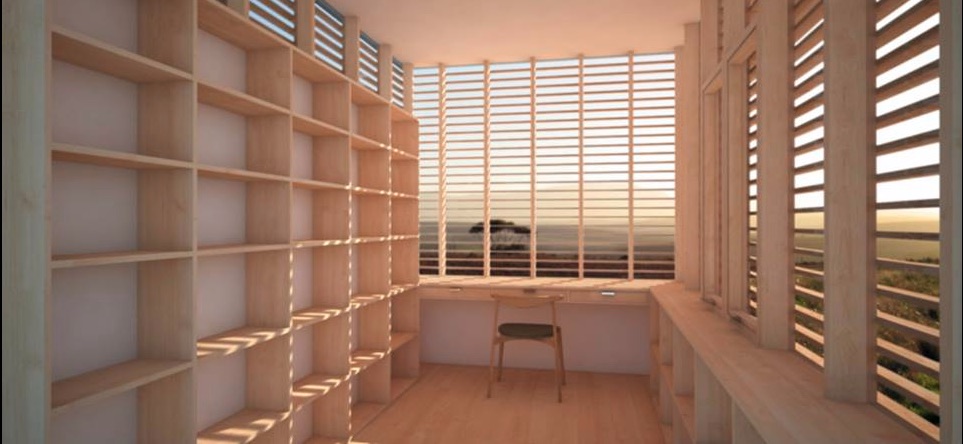
The library is a compact, 10 m² studio with built-in shelving. It has cedar rainscreen cladding, R20 insulation, tilt-and-turn windows, and high-efficiency LED lighting. The library was donated by Western Camera Building president John MacFarlane. Western Camera is known for constructing tiny buildings for use as offices, storage facilities, and—in this case—as a library.
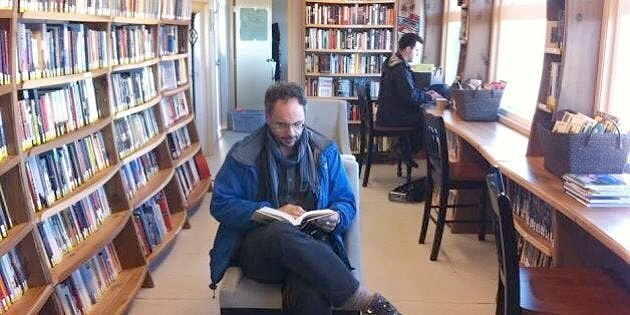
The interior of the library shows space for hundreds of books, and seating for computer use by one person at a time. The floors are easy to clean. Some of the windows open.
Based on the National Building Code for above-ground walls, insulation rated R20 exceeds both the “Good” and “Better” standards for above-ground walls in all zones across BC.
The community library, on a trailer, on its way to Metlakatla.
The library, which the community nicknamed Hobbit House, made the overwater portion of the trip by ferry, a service that BC Ferries provided for free.
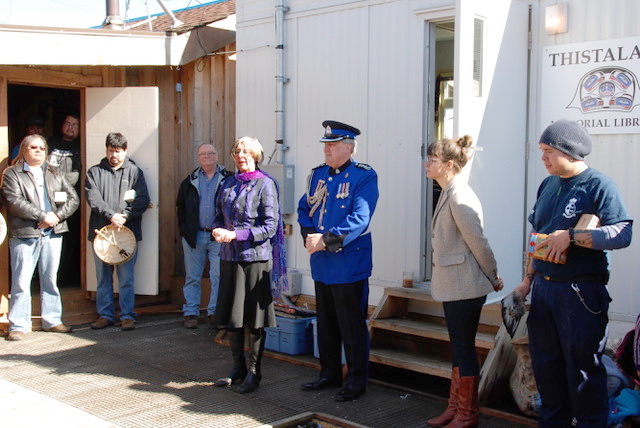
The Heiltsuk First Nation and the Qqs Projects Society officially opened the Thistalalh Memorial Library in Bella Bella on March 26, 2014. Qqs is pronounced kuks, means eyes, and refers to the community’s watchful stewardship of the area.
The portable building that now houses the library was renovated and shipped to Bella Bella complete with shelving and computers thanks to a unique partnership between Write to Read BC and its partners. The Rotary Club led the project’s fundraising. Britco Structures (now Boxx Modular) provided the portable building. Nanaimo Correctional Centre built the shelving. London Drugs provided computers that allow the library to offer remote attendance in courses and conferences online, in its learning centre. Other supporters provided shipping, books, and volunteers.
The library is home to books donated from around the world after the town’s previous building burned down. “We are incredibly moved by the upwelling of support from strangers and booklovers who want to help us get back on our feet and put books back in the hands of our community members,” said library curator Jessie Housty. She told The Tyee news that the library is “a gathering space around stories.”
Cozy, curved shelves create the illusion of space inside the portable building that houses the library.
Housty added: “Stories are sacred things. As Heiltsuk people, we really are nothing more than the sum of the stories we have lived in.” In addition to books and stories important to its culture, the library and its learning centre form an online bridge to other places and cultures.
Community members and lieutenant-governor of BC Judith Guichon stand in front of the Write to Read BC library at its opening ceremony.
The Write to Read BC library has a beautiful view of the Inside Passage, the sheltered waterway between the BC mainland and Vancouver Island. Travel to Bella Bella is only by sea and air.
The original library was built in 2007 by Qqs Projects Society, a Heiltsuk First Nation non-profit organization.
On a recent visit to Ditidaht, one Write to Read BC volunteer brought along a digital camera rto donate to the school. He described the camera as “an old Panasonic Lumix SLR” but adds: “It’s amazing what can be accomplished using digital technology. Computers and digital cameras have changed the world in which we live. Pretty soon everybody will be a movie maker.”
That includes the 10 high school students at Ditidaht’s community school.
The Lumix camera has a 24× zoom, a Leica glass lens, built-in image stabilization to reduce motion blur, and a memory card. It shoots great photos. It was given to the teacher for use by the high school students.
Students to make a digital diary
From January to June 2014, high school students will use the camera to take photos of their daily life: going to school, playing, at home, with friends, in the community. Students can also take photos in the woods and on the water.
The camera’s memory card can store thousands of images, and the students are encouraged to photograph everything they see. Their teacher, Eva Clarke, will select the best images and store them on a computer.
The learning objectives of this project are to:
learn digital photography.
learn to see and document village life.
self-publish a book—perhaps an e-book.
A digital diary that shows what life is like in the Ditidaht village can introduce people to a place few will ever get to visit in person. By using a camera, connecting people from elsewhere to an isolated community like Ditidaht is as easy as point and shoot.
The project runs from January to June, 2014.
Ditidaht teacher Eva Clarke will choose the best images that students take of their life in and around the village.
For Rupert celebrated the grand opening of a library, on August 20, 2013. Fort Rupert is a west-coast, First Nation community located next to Port Hardy, BC. This is the 8th library installed in an isolated community by Write to Read BC.
This library was a collaborative effort between participating partners. Three Rotary Clubs—Burnaby Metrotown, Port McNeill, and Port Hardy—worked in partnership with the Kwakiutl band of Port Rupert. Britco Structures (now Boxx Modular) donated the modular building, and BC Ferries assisted with its delivery. TLD Computers, with London Drugs and Hewlett Packard, donated the computers.
The contents of the library—the books, cataloguing, computer systems, and shelves—were assembled by Write to Read BC’s library response team, Carol and Barbara. In what was a truly cooperative effort, they were joined by Bonnie Sutherland of North Delta Rotary Club and Afroteck, and Marion Hunt, Carole Ford, and many other Fort Rupert community volunteers.
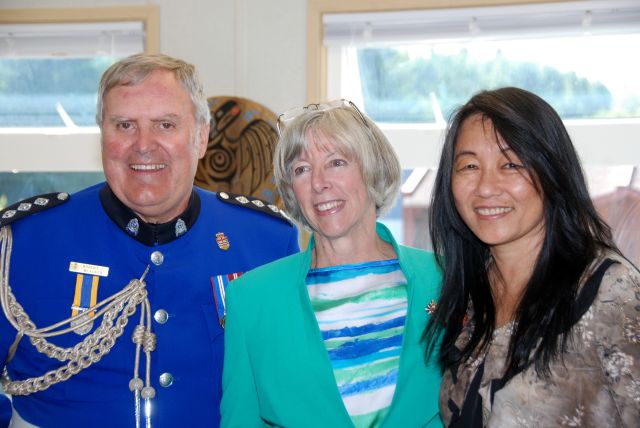
Lieutenant-governor of BC Judith Guichon opened the library. Also in attendance at the opening were Rotary District Governor Ken Wilson (D5040) and Peggy, along with Gloria Wing Stadt, Bala Naidoo, Elizabeth Cheung, and Darlene Broadhead of the Burnaby Metrotown Club.
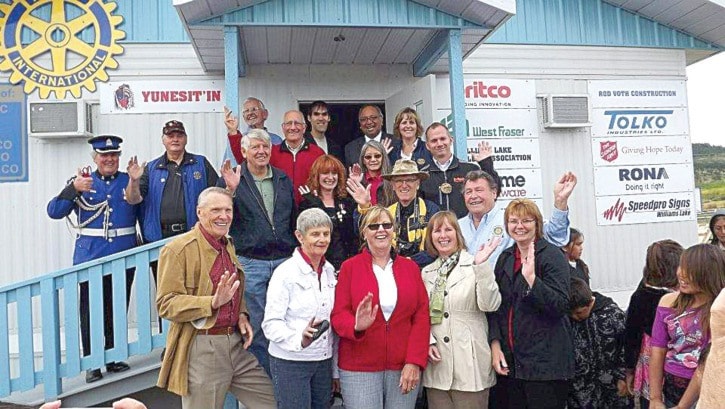
On September 11, 2012, the BC community of Yunesit’in, Stone, opened a library, thanks to Write to Read BC.
The Rotary Club of Williams Lake joined the community to install and open the facility. The Rotary Club of Sechelt gave a $15,000 grant for books. Steven Point, the lieutenant-governor of BC, attended the opening.
Point said the library is an example of what can be accomplished when people work together.
Britco donated a 10×40-foot trailer that was used during the 2010 Olympics by the media, and transported it to Stone. The Rotary Club Williams Lake purchased a second trailer. The community itself told its partners their vision: a library and a community centre.
People celebrate the opening of a combined library-community centre.