Tag: isolated

  • Heiltsuk

    About the community

    The present-day Heiltsuk Band of Indians, formerly Bella Bella, are the main descendants of Hailhzaqvla-speaking peoples who inhabited an area of approximately 15,000 km² in the central coastal region of BC. Heiltsuk traditional territory extends from the southern tip of Calvert Island, up Dean and Burke Channels as far as Kimsquit and the head of Dean Inlet to the northeast, and up the Mathieson and Finlayson Channels to the north. It includes Roscoe, Cousins, and Spiller Inlets, Ellerslie Lake, the outer coast regions of Milbanke Sound, Queens Sound, the Goose Island Group, and Calvert.

    The word Heiltsuk

    Heiltsuk, according to grandmother Hilistis Beatrice Brown’s personal communication, originally referred to all Aboriginal people or groups elsewhere. For example, the Gitsxan would have been referred to as Heiltsuk. Over time, as Indian Bands and reserves were established, the present-day Heiltsuk Band was initially registered as the Bella Bella Band, then renamed to Heiltsuk as its formal Title name.

    There is also reference to Heiltsuk meaning to speak and act in the right way, which reflects a traditional value that was a foundation of our principles and relations.

    Heiltsuk College

    The Heiltsuk College is a First-Nation-owned community college in Bella Bella. It offers post-secondary academic programs and training. Waglisla Adult Learning Centre is a seamless adjunct of Heiltsuk College and it offers upgrading programs from basic literacy to Adult Dogwood Grade 12 graduation. This educational institution has been in place for approximately 40 years and is housed in a church basement and in two aging portable trailers.

    Aboriginal Student Transitions handbook

    Based on the history of successful transitions of Heiltsuk College students from Bella Bella to off-reserve continued education or training, IAHLA took notice and wanted to research what made our college unique in this way. When Joann Green was an instructor, she developed a College Survival Skills mini-course that was a mandatory course for any student who planned to leave the community to attend further education or training elsewhere. Its focus is life skills training, but also gave students a practical tool for navigating systems in the city, such as the transit buses, applying for rental housing, etc. The student supports didn’t end when a student left town—they continued to be supported long distance and received encouragement, Heiltsuk food gifts, or whatever else was required to make their transitions easier. IAHLA worked together with UVIC and NVIT to do create the Handbook, and out of this came the ongoing practice of hosting aboriginal students on campuses in order to give them direct experiences and inspire them to move forward. Several Heiltsuk university students have participated and benefited from this initiative including Jessica Humchitt, who is enrolled in Health Sciences at SFU. This wrap-around service is seen as a best practice because it is a natural process that not only supports but also dignifies students.
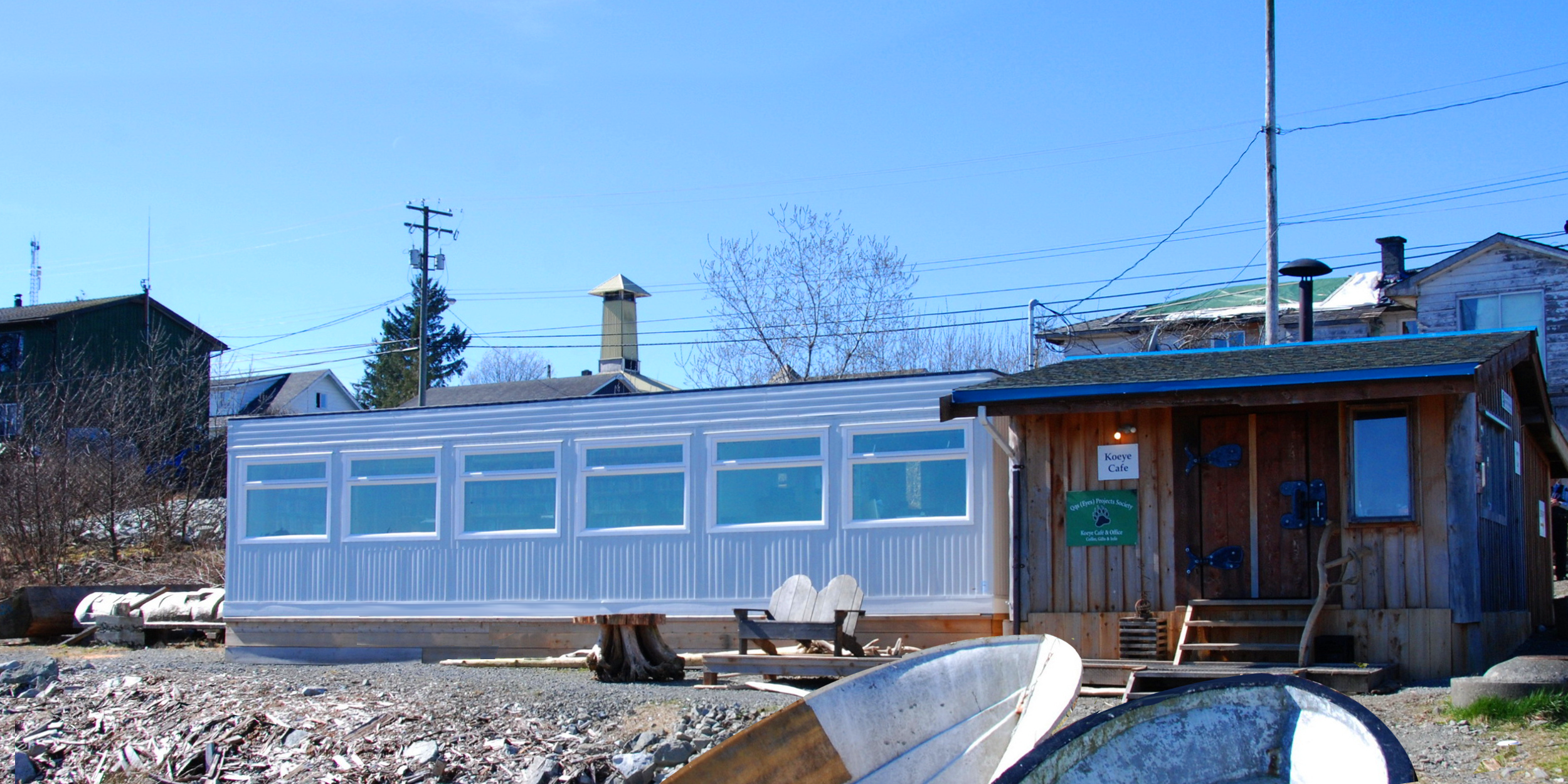
    Heiltzuk learning centre in Bella Bella.
    Facing the shore is the Write to Read BC library in Bella Bella, along with a wooden deck, chairs, table of the Koeye Café. Two boats are pulled up onto the shore.

    About the library

    In 2019, the community planned an immediate temporary space for an Employment Centre, and a multipurpose structure that would include Heiltsuk College, MCFNTS, and Employment and Training Centre by 2020.

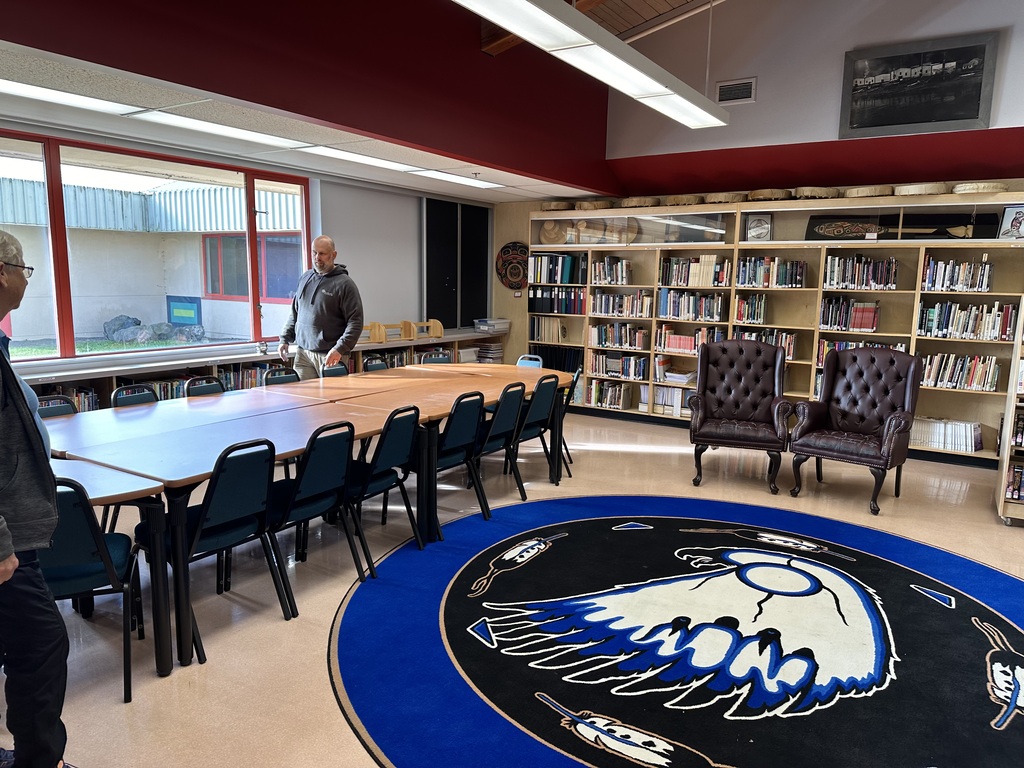
    The Bella Bella library is the fifth Write to Read BC library. Sponsors included Rotary Club of Steveston, and Britco Structures (now Boxx Modular).
  • Gitanmaax

    About the community

    The Gitanmaax Band are Gitxsan people live where the Skeena and Bulkley rivers meet, in north-western BC near Hazelton. Gitanmaax was the name of the winter village, which became the current reserve. Gitanmaax means People who Fish by Torchlight.

    The Gitanmaax Band currently has about 800 members living in the community, and about twice as many more living elsewhere.

    Every 2 years, members elect a Chief and 12 council members. Each council member is appointed a portfolio of services that the band administration delivers to the community:

    • Community-member services, including education, social development, child and youth wellbeing, and health.
    • Infrastructure and community services, including lands, housing, public works, and public safety.
    • Professional services, including administration, finance, economic development, band membership, legal counsel, and company management.

    About the library

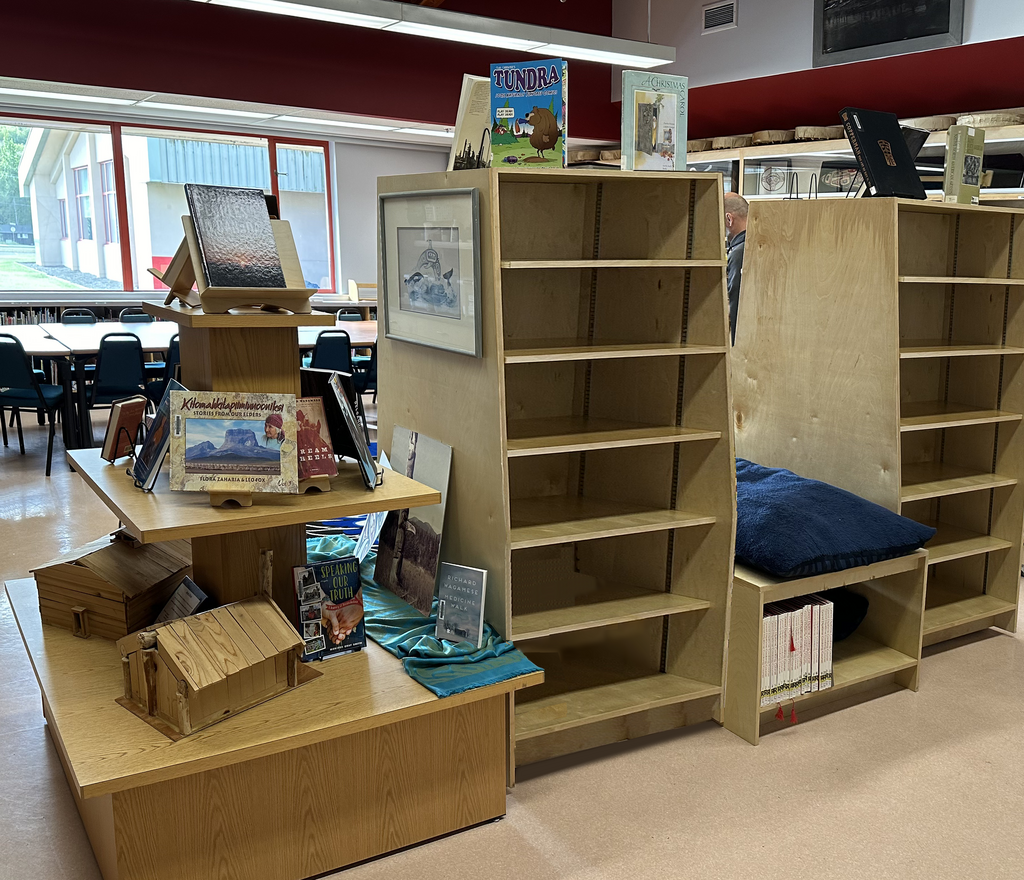
    Write to Read BC installed a library in Gitanmaax, in collaboration and partnership with the community and council. The library is in the community school, and includes display cases for important cultural objects, wooden models of traditional Indigenous housing, and books about a range of Indigenous cultures and lands.

    Hazelton school library, installed by Write to Read BC, with space for working and meeting.
    The newly installed books and important cultural objects.

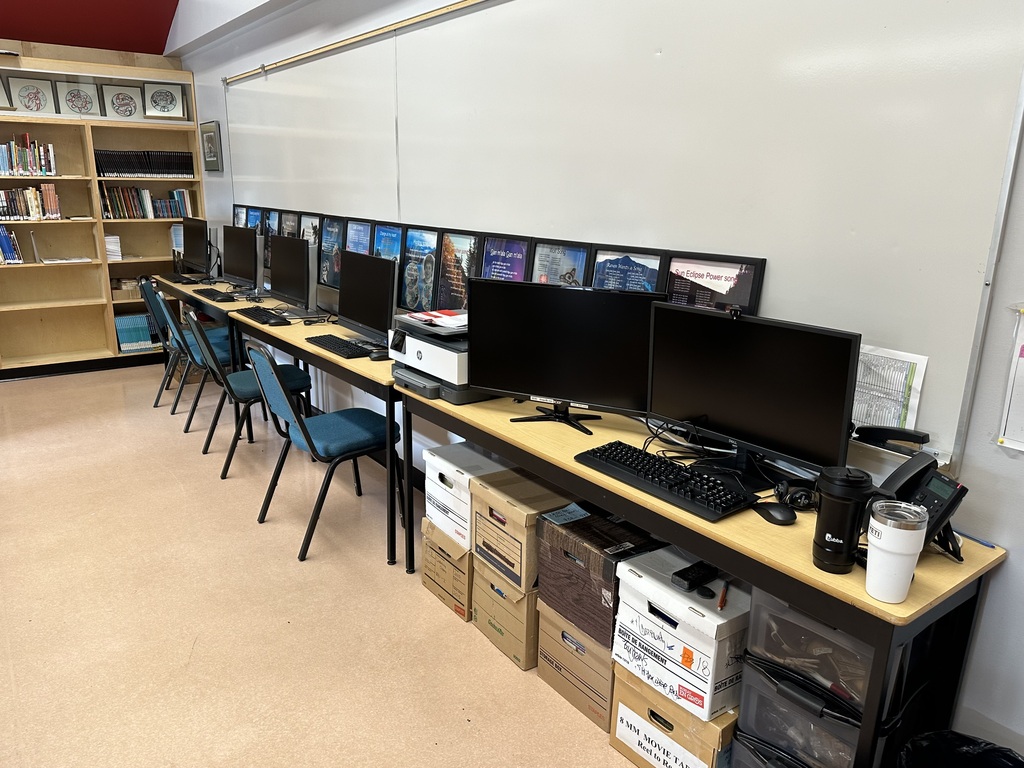
    The library has tables and seating for working and meeting. Along one wall, it has computers and screens to allow remote attendance at online courses and conferences, in its learning centre.

    The learning centre in the Hazelton school library.
    Four workstations and a printer, with the capacity to grow the library’s learning centre.
  • Lheidli T’enneh Fort George library

    Leaders of Lheidli T’enneh First Nation, educators, and Write to Read BC volunteers have discussed the community’s vision for an indigenous-led library. A library offers support for programs that interest the community.

    Also, the library’s collection will represent Indigenous communities.

  • Lheidli T’enneh

    About the community

    The Lheidli T’enneh Band, previously the Fort George Indian Band, are Dakelh and Carrier people who lived where the Nechako River joins the Fraser River, and traditionally included the city of Prince George, BC. Lheidli T’enneh means “The People from the Confluence of the Two Rivers.

    The band used temporary and seasonal settlements across their territory, and archeological evidence shows fishing camps along the Nechako and Fraser rivers as well as in the Beaverly area. The Lheidli T’enneh did not have permanent settlements in what is modern day Prince George until the 1820s arrival of the Hudson’s Bay Company post, Fort George, after which they also began keeping gardens.

    The band government focuses on:

    • Natural resources and stewardship, including hunting permits, lands, fisheries, and related laws.
    • Community services, including health, family development, employment and training, social assistance, and education.
    • Engineering and operations, including ancient forest enhancement, infrastructure asset management, housing, IT, and water treatment.

    The community also has an Elders society whose purpose is to protect and encourage Lheidli T’enneh traditions, language, and culture through access and education.

    About the library

    In a partnership, Write to Read BC and the Lheidli T’enneh Band are designing a library. As the project continues, the library may be installed in 2025 or 2026.

  • Gitanmaax library gets shelving

    Near the village of Hazelton, Write to Read BC volunteers recently delivered custom shelving required for the community’s school library. The shelves will also display important cultural objects, in both enclosed and open displays.

    New shelving and open displays of culturally important objects.
    New shelving, to be filled with books by the library response team. On the left is an open display case that shows framed historical photos and wooden models of traditional Indigenous housing.

    The school’s plan is nearing completion. The shelves were built for the library by Nanaimo Correctional Centre.

    This is the 23rd library the Write to Read BC project will install in isolated communities across BC, in partnership with the community.

  • Daylu Dena, Lower Post

    About the community

    Daylu Dena, or Lower Post, are Kaska Dena, a tribal council of people in northern BC, the Yukon, and Northwest Territories. Lower Post is on the Alaska Highway, at the northern border of BC and the Yukon, near Watson Lake. About 300 people live in Lower Post. Daylu Dena are a matriarchal society with interrelated families.

    Traditionally, Kaska Dena were a nomadic nation travelling across 100,000 km² of traditional territory to hunt and trap, and trade with neighbouring Nations. In some ways the nomadic life continues as community members continue to follow the seasons, and hunt and gather. Environmental protection is a focus, as is economic development.

    The Daylu Dena Council runs a company that provides a broad range of construction services and heavy-equipment rental across the Yukon and northern BC, ranging from roadworks and earthworks to residential construction, and from labour procurement to environmental remediation.

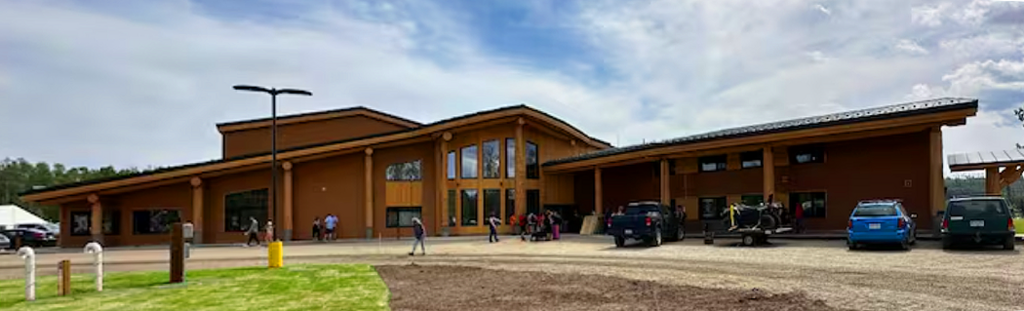
    The community completed a cultural and administrative centre in spring 2024—a building intended as offices for the council, and Services BC. It has a gymnasium, coffee shop, kitchen, library, and more.

    The civic building in Lower Post.
    The building will also house an Indigenous library.

    About the library

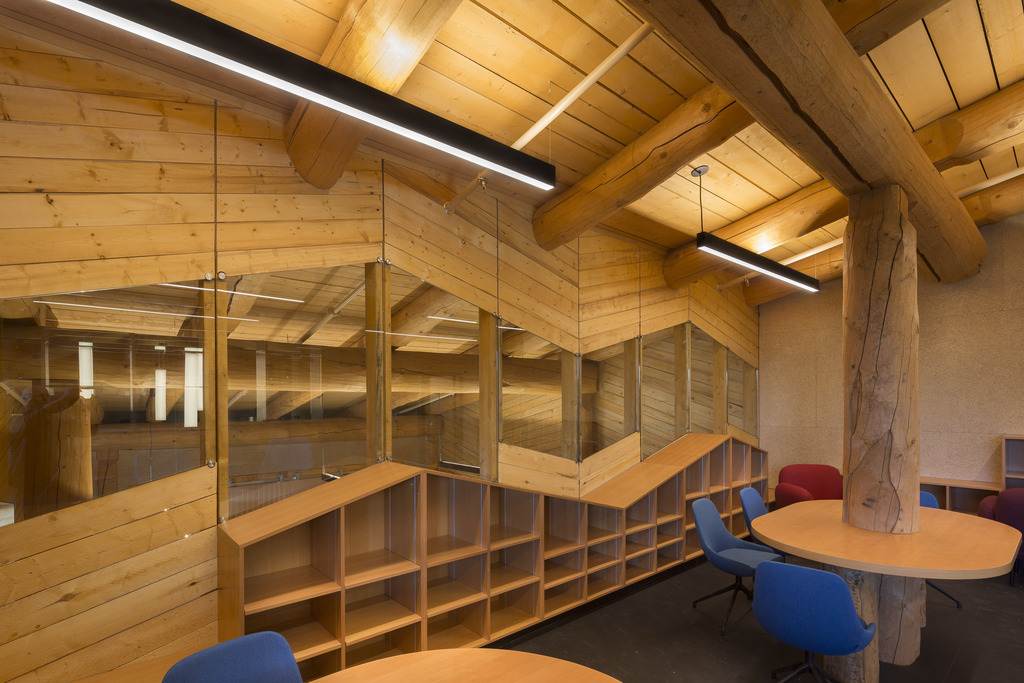
    The library that Write to Read BC installed in Daylu Dena’s civic building focuses on Indigenous books. The library opened in the spring of 2024.

    The partially installed library in Daylu Dena cultural and administrative building.
    The library was furnished with shelves under the contract for the entire building. Write to Read BC’s library response team helped install the books, computers, and screens.
  • Preparing to install Daylu Dena library

    Write to Read BC’s co-leads met to plan the installation of books and equipment in the Daylu Dena civic building by the end of the year.

    The building was completed a year ago, and the community and Write to Read BC are both eager to see the library installed.

    Since the library was built as part of a larger contract, it came fully finished with shelving and furniture. Write to Read library response team only needed to provide the books and computers, including a monitor. This reduced the need for financial input from Write to Read BC.

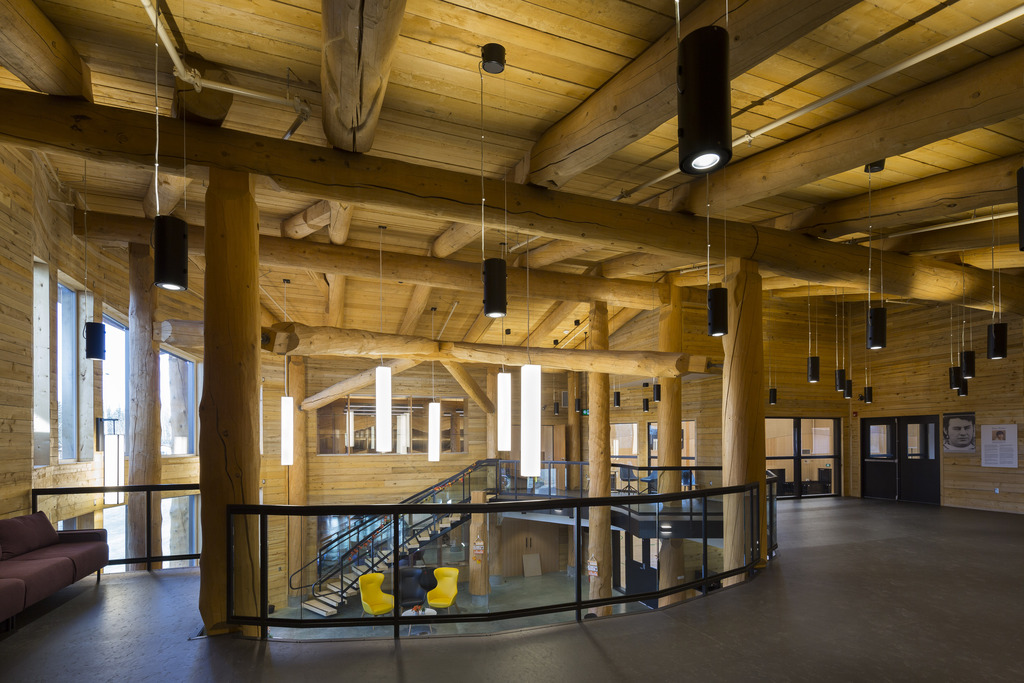
    Foyer and offices upstairs in Dalyu Dena's cultural and adminsitration building.
    The library is on the upper level, with a glass wall to admit plenty of light.
  • Visit to Daylu Dena’s civic-building site


    This month, Write to Read BC’s design response team visited Daylu Dena, just south of Watson Lake, BC. Visitors included lead architect Scott Kemp and Ryan Arsenault.

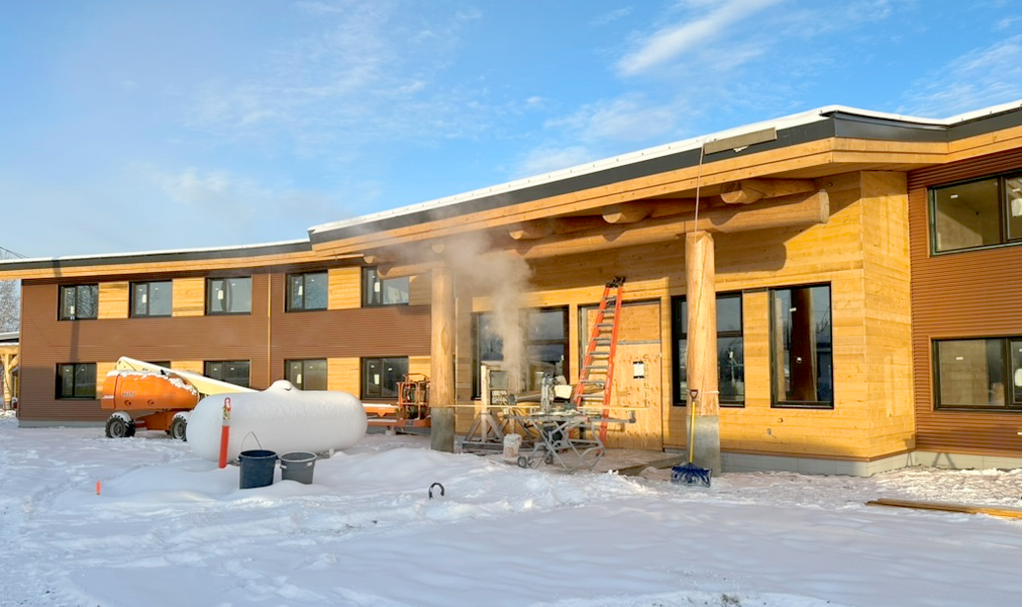
    Daylu Dena civic building: a construction site in winter.
    For our visit in late 2023, the Daylu Dena civic building was a winter construction site.

    The community is constructing a cultural and administrative building that will be completed in 2024. The building will have:

    • a Service BC office for driver’s licensing and other government business.
    • administration offices and a council chamber for Daylu Dene community business.
    • an adjoining room for the judge’s chamber, so the council chamber can be used as a court room.
    • a large gym.
    • a commercial kitchen and a coffee shop.
    • a recording studio, and language room.

    An Indigenous library

    Of course, the Daylu Dena civic building will also have a Write to Read BC library, the first to be stocked only with Indigenous books.

    A site visit to the cultural and administration building as construction approaches completion.
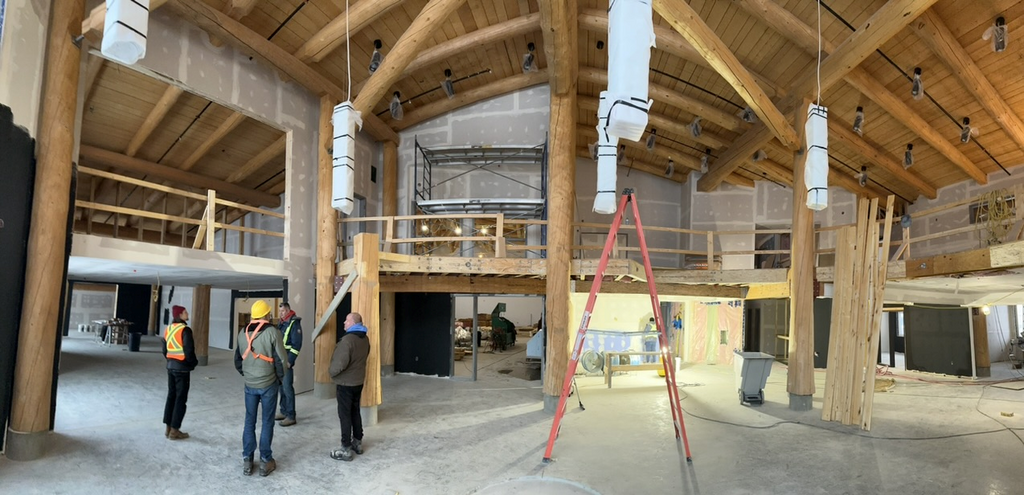
    Write to Read BC volunteers inside the construction site, looking up at the future location of the library.

    The library is planned for the top floor, overlooking the foyer. Its glass wall will admit lots of light.

    There team will return in 2024 to help plan the library with the community.

  • Guest speaker at BC Library Association

    Write to Read BC volunteer Margaret Fletcher will speak to the Community-Led interest group of BC Library Association, or BCLA. Fletcher will discuss how Write to Read BC partners on projects in isolated communities across BC. She’ll also talk about the impact these projects have on social barriers and reinforcing community culture. This includes the installation of Internet-connected computers that provide remote access to courses and conferences through these learning centres.

    The association’s interest group meets quarterly, with its next meeting in December.

    BC Library Association logo.

    The BCLA Community-Led interest group is about a community-led service approach, which consists of community consultation, needs assessments, metrics, and ongoing monitoring of services and programs. The interest group’s members want to connect and collaborate with community members to better support their needs.

    At its core, the community-led model is about reducing or eliminating barriers to library services and programs. Another key factor to the community-led approach is staff training and development within the communities.

  • Write to Read BC at LAMNS conference

    Write to Read BC has been selected to participate in a panel discussion at the conference for Libraries, Archives and Museums Nova Scotia (LAMNS). The panel will discuss its partnerships with isolated BC communities to install indigenous-led libraries.

    The panel takes place on Friday, October 22, and includes our co-lead Bob Blacker, co-lead Dr Shirley-Pat Gale, and volunteers Louise Ormerod, Sarah Dupont, and Gordon Yusko.

    The conference theme is Moving Forward Together: Collaboration and innovation to meet changing needs. The theme highlights the resilience of the three sectors—libraries, archives, and museums—as they developed ways to collaborate with communities from a distance due to Covid-19.

    Logo of the Libraries Archives and Museums Nova Scotia.