Plans for a Xeni Gwet’in library are on track. This is our very first Version 4 library—one that will be built on site, rather than premade and shipped in. The library’s opening date depends on how the design and building proceed, and on funding for that to happen.
Before we can ask the Jack Gin Foundation to support it, our construction response team will need to determine exactly how much this library will cost to build.
The building for the Ahousaht community library is in place, and Write to Read BC’s construction response team has visited the site to view the building.
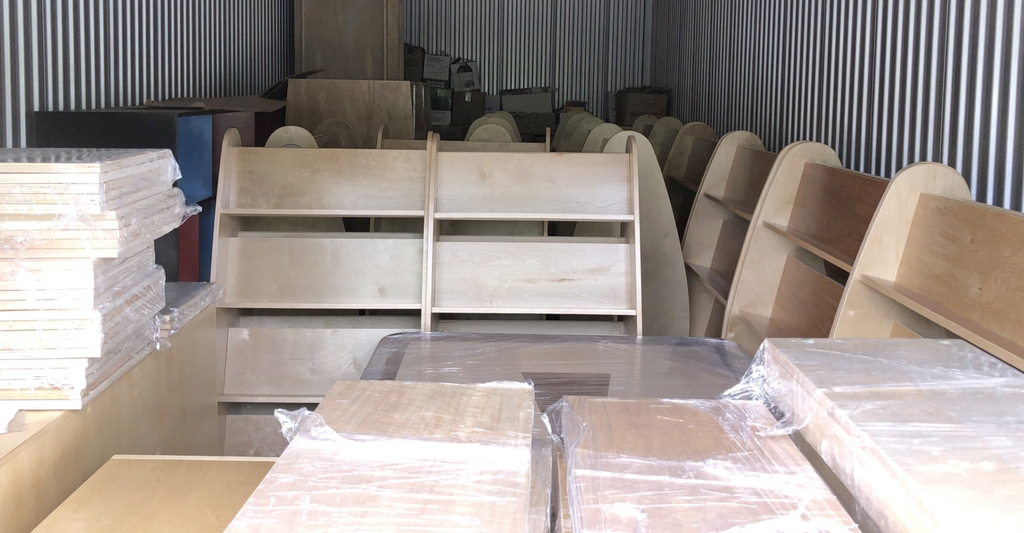
Our library response team is now putting together a collection of books. Furniture has to be made and delivered when the library response team sets up the library.
The library will likely open in the fall of 2014. It’s another success story for the partnership model, which matches communities, Write to Read BC volunteers, and other partners.
This small, BC community is in the process of designing and building a new pre-school with the help of Scott Kemp, who is also our Write to Read BC architect.
The community is adding to the building design a portion that will serve as a community library. This project is a partnership with Write to Read BC.
Quatsino is located northwest of Port Hardy, on the BC coast.
Progress for the Write to Read BC project in Wuikinuxv, or Oweekeno, Rivers Inlet, has been encouraging. In fact, volunteers and project partners have already made several visits, to contribute their work to this partnership.
Write to Read BC’s design response team made two trips to Oweekeno—including Christoph Neufeld from Britco Structures (Now Boxx Modular) and the project’s architect Scott Kemp. The meetings and brainstorming with the Oweekeno team developed a vision for a building that we now call the Child of the Big House. This resulted in plans for the building, and a supplies list of required materials, which were handed off to the construction response team.
Write to Read BC’s construction response team will project-manage the 24×34 m building, its pad of steel-reinforced concrete, and dozens of massive wood posts and beams.
Milling logs, mixing cement, transporting steel
The amount of cement required for a pad that’s 15 cm thick is daunting, so the team wanted to use a cement batch plant that would make the cement in a quarter of the time of small mixers. The community went on a search to find such a plant. As with everything on this project, we were able to find a supplier, and a company is willing to contribute. Otherwise, the cost would have been prohibitive for this particular machine.
Finding a way to ship the cement and reinforced steel bars is still on the team’s to-do list.
Western Forest Products and Interfor Corporation are donating the logs to the community. The community in turn will be milling the lumber to the specifications provided by Kemp, the project’s architect. To hold up the roof, the design requires two beams, each 34 m in length and 1.2 m wide. The community and two lumber companies are looking for two trees now, and are confident they can find them. The community’s team lead said, “If we do, the Creator again is working with us.” The community also needs 6 posts of 1.2 m wide, and 16 posts 90 cm wide.
The team is also speaking with Seaspan in North Vancouver, to find the right type of barge to unload a 13 m prefabricated Britco building on the beach at Oweekeno.
Volunteer labour
Write to Read BC members approached Richmond Firefighters and left them with plans of the building. As volunteers they are very eager to help with construction, but because of summer leave cannot start until September.
With a batch plant for the foundations and cement pad arranged, scheduling the firefighters will be easier, and the pad is expected to be finished before the end of September, with building construction well underway.
It’s all donations, no taxpayer dollars
Lions Gate Rotary Club of North Vancouver has taken the lead on fundraising for this Write to Read BC project.
The project uses no public funds and has no administration costs. Every dollar donated has gone straight into the purchase of materials. The success of the project is that urban companies and groups in BC towns and cities are partnering with isolated, Indigenous communities via Internet. They’re bridging the geographical and cultural gap simply through mutual kindness and trust.
“So far, I think the value of donations of time and materials is about $458,000,” said Write to Read BC’s co-lead Bob Blacker, adding: “We are developing a team of great volunteers here, and all the donors have been very generous.” Blacker arranged all of this with the help of a long and growing list of donors.
The value of the logs provided by Western Forest and Interfor is $65,000. Additional funding was made possible by Vancouver Coastal Health, a partner on this project. They provided a way for the project to apply for $25,000 toward construction.
“The key to getting this project done is that it is all community based,” says project architect Kemp, in this video:
“We are not joining the government queue and waiting for handouts. We are simply going out and doing it ourselves, and it’s been a huge success,” said Kemp.
A template for future projects
This by far is the largest project Write to Read BC and a Rotary Club have ever done. Logistically, it has been a huge challenge but the construction response team is managing its way through. Meanwhile, the library response team—which will install the bookshelves and books, technology, and furniture, and which will provide training in library management—is preparing for the last stage.
This project may serve as a template for future projects in other isolated communities across BC. It’s also an opportunity for Oweekeno community to tell the world about itself, says Write to Read BC’s Kemp:
Write to Read BC’s co-lead Bob Blacker reports that the BC Correctional Service, through two of its facilities on Vancouver Island, have agreed to build furniture for Write to Read BC libraries.
First Nations inmates will build bookshelves, computer stations, coffee tables, and any custom work that may be required for libraries that Write to Read BC installs in isolated, Indigenous communities across BC.
Not only will libraries have a choice of shelving types, the shelving can be custom fitted for each library space.
With the help of Windsor Plywood, Write to Read BC will arrange for the required materials. The Correctional Facilities will build the furniture. Another positive aspect of the agreement is that First Nation inmates will be able to help build the furniture, certainly a win/win for all involved.
Shelves will be picked up by volunteers and taken directly to a waiting library or stores in the Write to Read BC distribution centre in Nanaimo.