Tag: libraries

  • Lheidli T’enneh

    About the community

    The Lheidli T’enneh Band, previously the Fort George Indian Band, are Dakelh and Carrier people who lived where the Nechako River joins the Fraser River, and traditionally included the city of Prince George, BC. Lheidli T’enneh means “The People from the Confluence of the Two Rivers.

    The band used temporary and seasonal settlements across their territory, and archeological evidence shows fishing camps along the Nechako and Fraser rivers as well as in the Beaverly area. The Lheidli T’enneh did not have permanent settlements in what is modern day Prince George until the 1820s arrival of the Hudson’s Bay Company post, Fort George, after which they also began keeping gardens.

    The band government focuses on:

    • Natural resources and stewardship, including hunting permits, lands, fisheries, and related laws.
    • Community services, including health, family development, employment and training, social assistance, and education.
    • Engineering and operations, including ancient forest enhancement, infrastructure asset management, housing, IT, and water treatment.

    The community also has an Elders society whose purpose is to protect and encourage Lheidli T’enneh traditions, language, and culture through access and education.

    About the library

    In a partnership, Write to Read BC and the Lheidli T’enneh Band are designing a library. As the project continues, the library may be installed in 2025 or 2026.
  • Gitanmaax library gets shelving

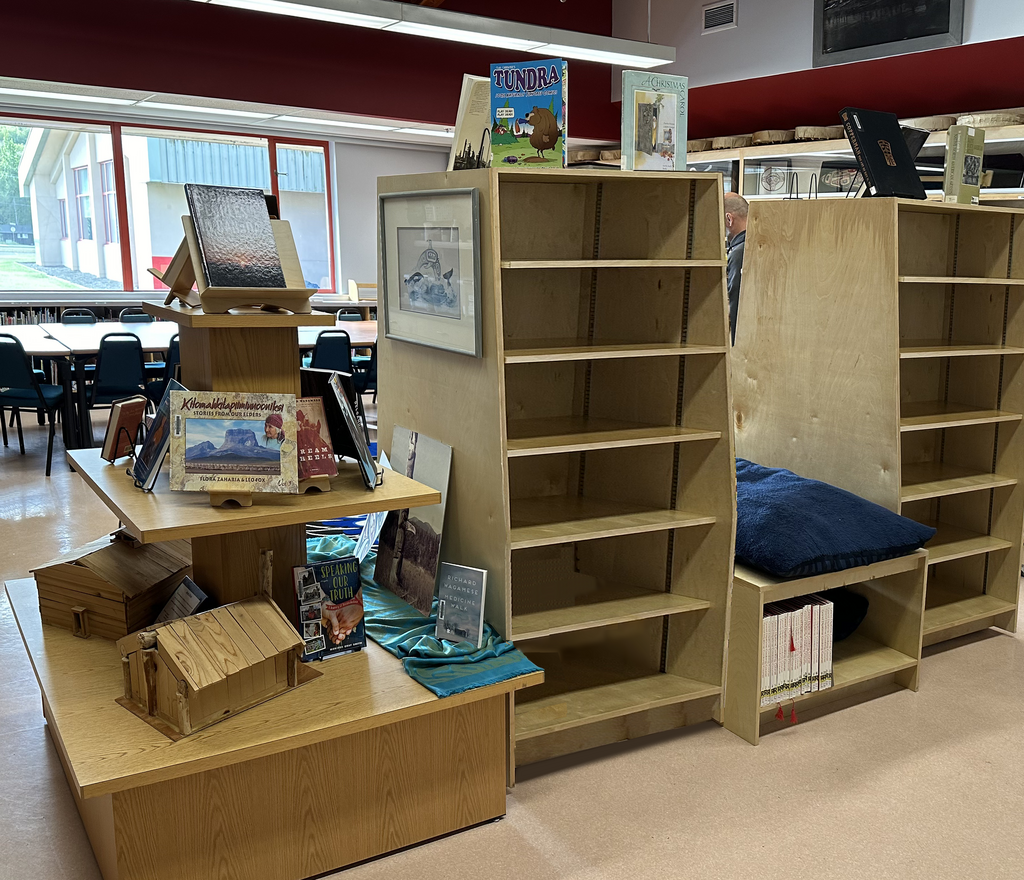
    Near the village of Hazelton, Write to Read BC volunteers recently delivered custom shelving required for the community’s school library. The shelves will also display important cultural objects, in both enclosed and open displays.

    New shelving and open displays of culturally important objects.
    New shelving, to be filled with books by the library response team. On the left is an open display case that shows framed historical photos and wooden models of traditional Indigenous housing.

    The school’s plan is nearing completion. The shelves were built for the library by Nanaimo Correctional Centre.

    This is the 23rd library the Write to Read BC project will install in isolated communities across BC, in partnership with the community.

  • Saving education in Gitsegukla: video

    When Gitsegukla elementary school principal Louise Ormerod talks about her school’s journey from failure to success—not just for the Kindergarten to Grade 7 students, but also for adult learners in the community—Write to Read BC gets part of the credit.

    School risked getting shut down

    In 2018 the BC Ministry of Education assessed the school. It failed. The ministry said the school would be closed if it didn’t resolve the 21 violations ministry auditors found. The community also knew the school was poor. Some families left the community so their children could get an education. New teachers quickly left.

    But two years later, when auditors returned, they found a vast improvement. The school was “teaching to the curriculum” and meeting BC Ministry of Education standards. Auditors observed the school had found the resources every elementary school needs. Literacy rates increased 400%. Teachers stayed.

    Community commitment, a plan, and a library

    Ministry auditors told Ormerod that hers was the only audited school that did not have a single violation that year. Ormerod credits her staff and the community’s commitment to saving education in their community. She says Write to Read BC not only played a role, but made it easy, by being prpared and by knowing who to call to solve various problems. As for the library Write to Read BC installed, Ormerod says, “we had the best library and learning centre we could have ever asked for to support that learning.”

    The story on video

    In this 9½-minute video of an online talk, Ormerod tells the story of her school’s journey.

    School principal Louise Ormerod talks about improving literacy and numeracy at her school.

    Ormerod also gives advice to other schools who want to develop a library of their own:

    • Give the library a formal opening, with all the fanfare it deserves, to acknowledge the accomplishment. Gitsegukla school missed theirs because of Covid-19 restrictions.
    • Identify a champion who’s passionate about maintaining the facility once it’s launched.
    • Open the library after hours, so adult community members can use the library, and can attend online courses by using the library’s learning centre.
    • Get trained to manage a digital lending system.

    Ormerod credits the expertise and connections of Write to Read BC’s volunteers, and the fundraising efforts of the Rotary Club for helping to make success possible for Gitsegukla Elementary and the whole community.

  • Daylu Dena, Lower Post

    About the community

    Daylu Dena, or Lower Post, are Kaska Dena, a tribal council of people in northern BC, the Yukon, and Northwest Territories. Lower Post is on the Alaska Highway, at the northern border of BC and the Yukon, near Watson Lake. About 300 people live in Lower Post. Daylu Dena are a matriarchal society with interrelated families.

    Traditionally, Kaska Dena were a nomadic nation travelling across 100,000 km² of traditional territory to hunt and trap, and trade with neighbouring Nations. In some ways the nomadic life continues as community members continue to follow the seasons, and hunt and gather. Environmental protection is a focus, as is economic development.

    The Daylu Dena Council runs a company that provides a broad range of construction services and heavy-equipment rental across the Yukon and northern BC, ranging from roadworks and earthworks to residential construction, and from labour procurement to environmental remediation.

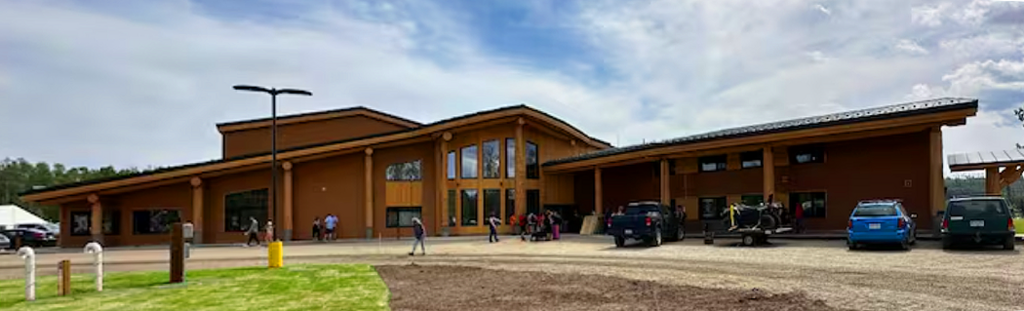
    The community completed a cultural and administrative centre in spring 2024—a building intended as offices for the council, and Services BC. It has a gymnasium, coffee shop, kitchen, library, and more.

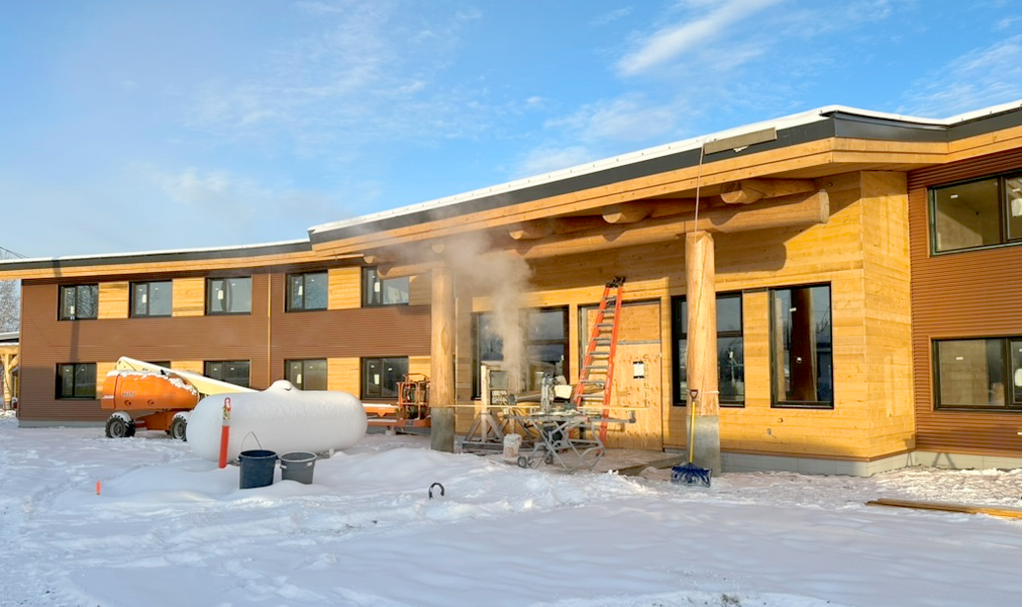
    The civic building in Lower Post.
    The building will also house an Indigenous library.

    About the library

    The library that Write to Read BC installed in Daylu Dena’s civic building focuses on Indigenous books. The library opened in the spring of 2024.

    The partially installed library in Daylu Dena cultural and administrative building.
    The library was furnished with shelves under the contract for the entire building. Write to Read BC’s library response team helped install the books, computers, and screens.
  • Preparing to install Daylu Dena library

    Write to Read BC’s co-leads met to plan the installation of books and equipment in the Daylu Dena civic building by the end of the year.

    The building was completed a year ago, and the community and Write to Read BC are both eager to see the library installed.

    Since the library was built as part of a larger contract, it came fully finished with shelving and furniture. Write to Read library response team only needed to provide the books and computers, including a monitor. This reduced the need for financial input from Write to Read BC.

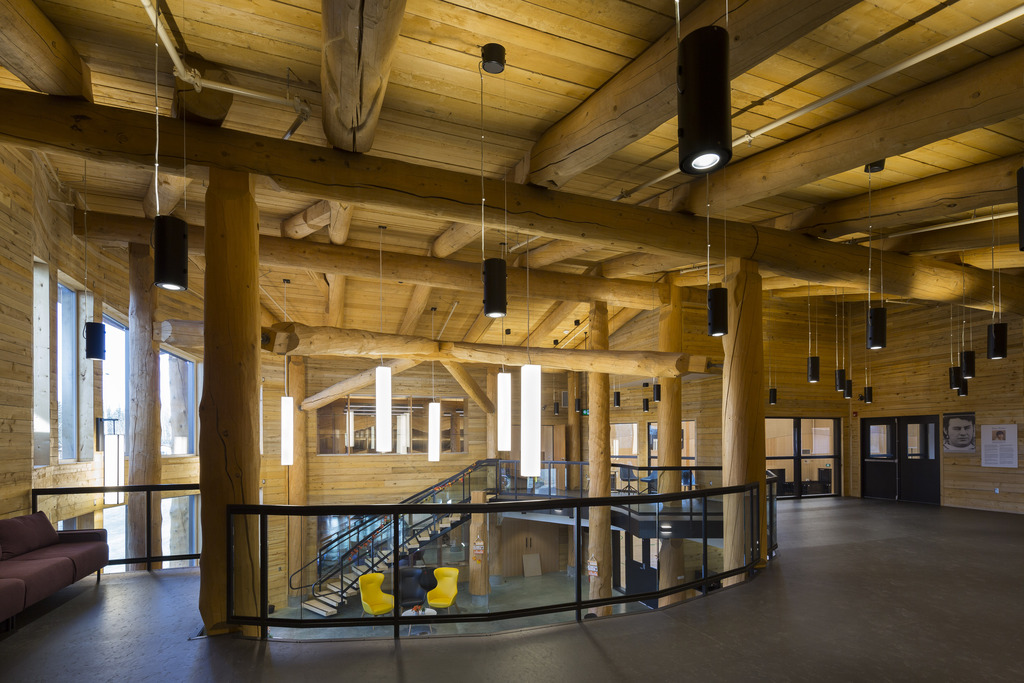
    Foyer and offices upstairs in Dalyu Dena's cultural and adminsitration building.
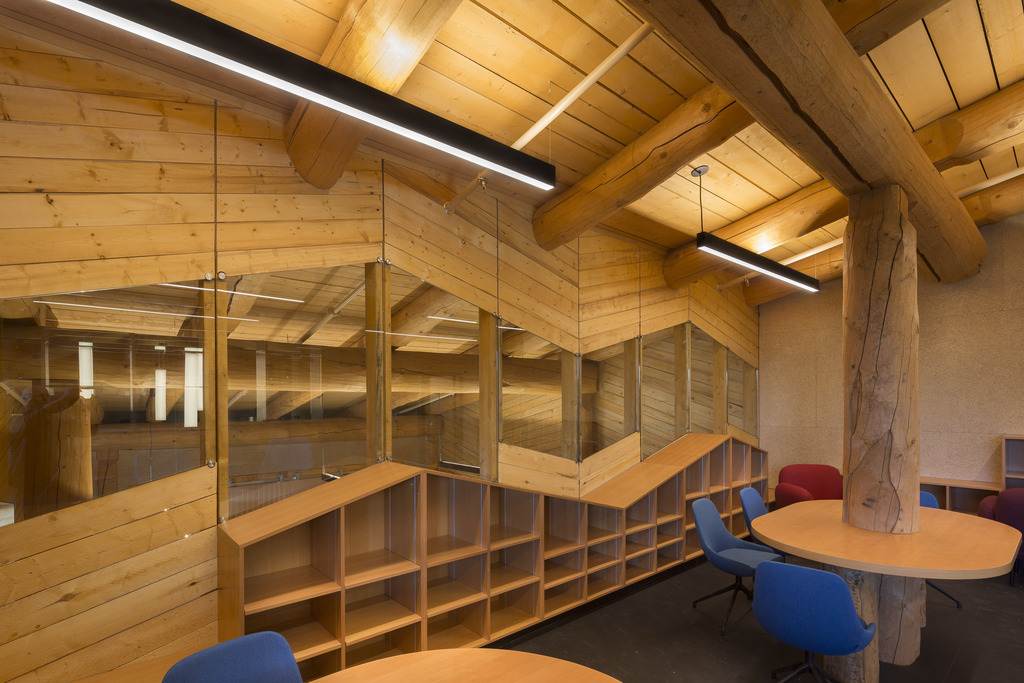
    The library is on the upper level, with a glass wall to admit plenty of light.
  • Visit to Daylu Dena’s civic-building site


    This month, Write to Read BC’s design response team visited Daylu Dena, just south of Watson Lake, BC. Visitors included lead architect Scott Kemp and Ryan Arsenault.

    Daylu Dena civic building: a construction site in winter.
    For our visit in late 2023, the Daylu Dena civic building was a winter construction site.

    The community is constructing a cultural and administrative building that will be completed in 2024. The building will have:

    • a Service BC office for driver’s licensing and other government business.
    • administration offices and a council chamber for Daylu Dene community business.
    • an adjoining room for the judge’s chamber, so the council chamber can be used as a court room.
    • a large gym.
    • a commercial kitchen and a coffee shop.
    • a recording studio, and language room.

    An Indigenous library

    Of course, the Daylu Dena civic building will also have a Write to Read BC library, the first to be stocked only with Indigenous books.

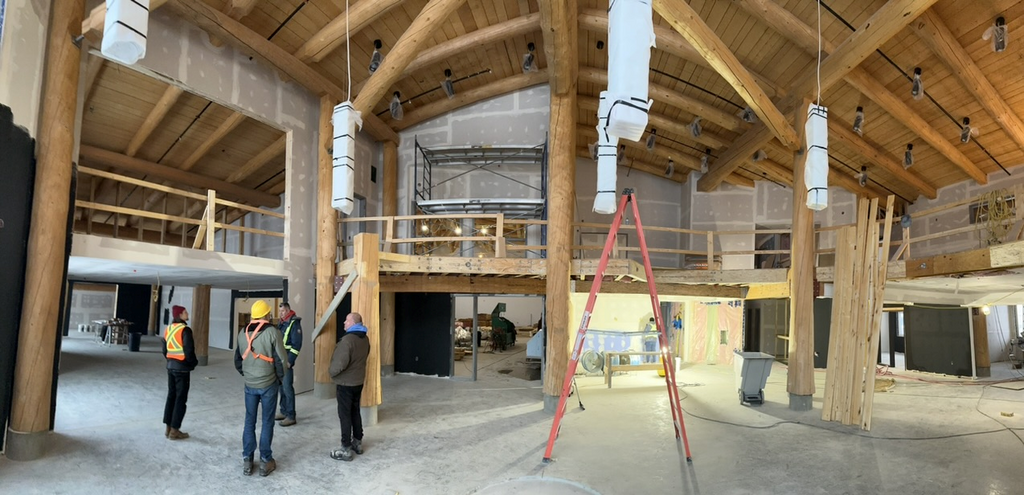
    A site visit to the cultural and administration building as construction approaches completion.
    Write to Read BC volunteers inside the construction site, looking up at the future location of the library.

    The library is planned for the top floor, overlooking the foyer. Its glass wall will admit lots of light.

    There team will return in 2024 to help plan the library with the community.

  • Capilano Little Ones gets library

    One of Squamish Nation’s urban schools, Capilano Littlest Ones Xwemelch’stn School, celebrated its new library in November 2022. The school is on Squamish land in Greater Vancouver.

    The school brings together 130 Indigenous and non-Indigenous students in the Norgate area of urban North Vancouver. The school and its library help break down social barriers, build bridges across cultures, and re-establish positive relationships. Capilano Littlest Ones is a community school under the auspices of North Vancouver School District.

  • Guest speaker at BC Library Association

    Write to Read BC volunteer Margaret Fletcher will speak to the Community-Led interest group of BC Library Association, or BCLA. Fletcher will discuss how Write to Read BC partners on projects in isolated communities across BC. She’ll also talk about the impact these projects have on social barriers and reinforcing community culture. This includes the installation of Internet-connected computers that provide remote access to courses and conferences through these learning centres.

    The association’s interest group meets quarterly, with its next meeting in December.

    BC Library Association logo.

    The BCLA Community-Led interest group is about a community-led service approach, which consists of community consultation, needs assessments, metrics, and ongoing monitoring of services and programs. The interest group’s members want to connect and collaborate with community members to better support their needs.

    At its core, the community-led model is about reducing or eliminating barriers to library services and programs. Another key factor to the community-led approach is staff training and development within the communities.

  • Write to Read BC at LAMNS conference

    Write to Read BC has been selected to participate in a panel discussion at the conference for Libraries, Archives and Museums Nova Scotia (LAMNS). The panel will discuss its partnerships with isolated BC communities to install indigenous-led libraries.

    The panel takes place on Friday, October 22, and includes our co-lead Bob Blacker, co-lead Dr Shirley-Pat Gale, and volunteers Louise Ormerod, Sarah Dupont, and Gordon Yusko.

    The conference theme is Moving Forward Together: Collaboration and innovation to meet changing needs. The theme highlights the resilience of the three sectors—libraries, archives, and museums—as they developed ways to collaborate with communities from a distance due to Covid-19.

    Logo of the Libraries Archives and Museums Nova Scotia.
  • Write to Read BC expands Indigenous networking

    Several members of isolated BC communities attended a virtual conference about Indigenous communities. The conference, sponsored by Libraries, Archives and Museums Nova Scotia, included breakout sessions.

    During the breakout sessions, members discussed their experience with Write to Read BC, and made new connections with people from Indigenous communities in other provinces.

    Virtual conferences don’t just give remote attendees access to people in other communities. They expose attendees to other ideas and perspectives, and to a broad body of knowledge and potential for collaboration.