Tag: outcomes

  • Value in isolated libraries: SFU study

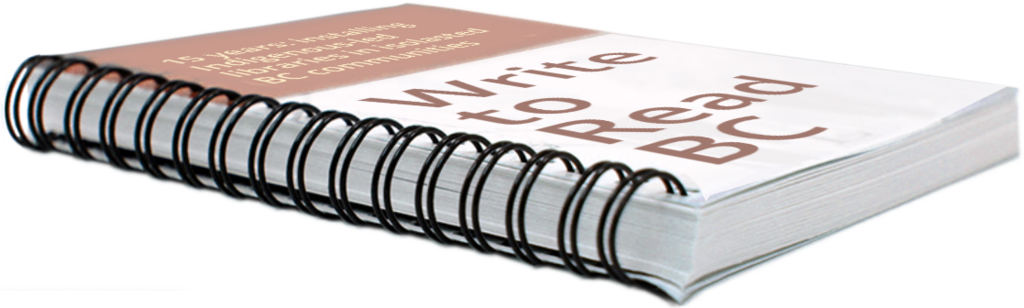
    Researcher and Simon Fraser University (SFU) graduate Jody Bauche recently spoke about 15 years of Write to Read BC projects. These projects are partnerships with Indigenous communities, to design and install the library they want. Bauche’s research findings suggest that isolated indigenous communities across BC gain substantially. The gains show up in several ways.

    Firstly, at a community-wide level libraries are places where people connect, according to Bauche. She found that Write to Read BC libraries foster resiliency and active community participation. The libraries are used as community hubs.

    Secondly, individual or “autonomous” library use is also connected to increased productivity within communities.

    Thirdly, the effect on literacy is positive. Bauche found an increased interest in literacy related to community libraries installed by Write to Read BC.

    Lastly, Bauche noted several community challenges indirectly related to libraries. For example, due to shifts in literacy funding, schools have been absorbing community-based programs. Also, expanding those community programs increases the demand for meeting space. A community library can ease the demands on schools and provide another place to host programs.

    Full details of the findings will be available when Bauche publishes her complete study, later this year. The study, which Write to Read BC requested, received funding from SFU Community-Engaged Research Initiative, or SFU CERi. This program helps community organisations understand the effectiveness of their efforts. During this research, Bauche applied her cultural insight as a First Nation member. And as a graduate of SFU’s Communication, Art and Technology faculty, she also brought her academic training.

    As for the findings, Bauche shared them first with Write to Read BC leaders and the Rotary Club of Steveston-Richmond. That’s because the Rotary Club is a significant funder of the Indigenous-led libraries that Write to Read BC volunteers install. Over the past 15 years, these partnerships have resulted in about two dozen libraries in isolated communities across BC.

    About Jody Bauche

    For about 2 decades after completing a 2005 degree in social work, Jody Bauche worked as an Indigenous social worker. More recently, she enrolled in SFU’s new program, Communication Research for Social Change. In this program. Bauche was among the first to graduate. She earned a Master of Arts in Communication with a project about supporting Indigenous sovereign and cultural production.

    In a mid-2025 interview about the Social Change program, Bauche spoke with SFU staff writer, Andrew Ringer. Bauche told Ringer that her work toward a master degree will help her ability to lobby government. It also helps her frame things in a way that inspires others to get on board with social change. Bauche said communication, art, and technology will help Indigenous people retain and develop their cultural knowledge. Bauche told Ringer that social change is non-partisan because everybody benefits.

    In addition to her research work, Bauche teaches communication in an Indigenous context at Royal Roads University. She also teaches social work at Camosun College.

    Research on the impact of Indigenous-led libraries installed together with Write to Read BC in isolated BC communities.
  • Promoting Write to Read BC with BCLA librarians

    Today, Write to Read BC announced the launch of this updated website to members of BC Library Association, or BCLA. That’s because BCLA members are well placed to promote the Write to Read BC project. The announcement also mentions an upcoming impact study about communities that have an indigenous-led library.

    BC Library Association logo.

    The role of librarians

    Librarians focus on advocacy, professional development, and support of intellectual freedom. BCLA members work to ensure everyone has equitable access to information, ideas, and works of the imagination. In contrast, Write to Read BC does the same by following the lead of First Nations communities.

    The announcement to BCLA

    This is what today’s announcement covered:

    On this National Day for Truth and Reconciliation it’s fitting to announce two things about the long-lasting Write to Read BC project.

    1. There is a new website, writetoreadbc.org.
    2. An impact study is in its final stages, with a report scheduled to be released in November.

    As many of you know, former lieutenant-governor of BC Steven Point envisioned and initiated this project during his time in that role between 2007 and 2012. A key partner in making the project a reality was his aide-de-camp at the time, Bob Blacker, an active member of a Rotary Club. CBC carried a story about this joint effort in May of 2014, as did various newspapers.

    Fast forward and along the way to 2025, Write to Read BC has collaborated with numerous Indigenous communities, under their leadership, to plan and install highly local libraries and learning centres. The new website documents these multiple efforts going back to 2011.

    Funding and support for the new website and the impact report was generously provided by SFU’s Main Street Research Shop. It collaborates with community partners, students, and faculty members to address community questions and concerns through research. The SFU Indigenous Student Centre has been equally generous in contributing in-kind support for a portion of the work schedule to co-supervise both the research and the web development.

  • Saving education in Gitsegukla: video

    When Gitsegukla elementary school principal Louise Ormerod talks about her school’s journey from failure to success—not just for the Kindergarten to Grade 7 students, but also for adult learners in the community—Write to Read BC gets part of the credit.

    School risked getting shut down

    In 2018 the BC Ministry of Education assessed the school. It failed. The ministry said the school would be closed if it didn’t resolve the 21 violations ministry auditors found. The community also knew the school was poor. Some families left the community so their children could get an education. New teachers quickly left.

    But two years later, when auditors returned, they found a vast improvement. The school was “teaching to the curriculum” and meeting BC Ministry of Education standards. Auditors observed the school had found the resources every elementary school needs. Literacy rates increased 400%. Teachers stayed.

    Community commitment, a plan, and a library

    Ministry auditors told Ormerod that hers was the only audited school that did not have a single violation that year. Ormerod credits her staff and the community’s commitment to saving education in their community. She says Write to Read BC not only played a role, but made it easy, by being prpared and by knowing who to call to solve various problems. As for the library Write to Read BC installed, Ormerod says, “we had the best library and learning centre we could have ever asked for to support that learning.”

    The story on video

    In this 9½-minute video of an online talk, Ormerod tells the story of her school’s journey.

    School principal Louise Ormerod talks about improving literacy and numeracy at her school.

    Ormerod also gives advice to other schools who want to develop a library of their own:

    • Give the library a formal opening, with all the fanfare it deserves, to acknowledge the accomplishment. Gitsegukla school missed theirs because of Covid-19 restrictions.
    • Identify a champion who’s passionate about maintaining the facility once it’s launched.
    • Open the library after hours, so adult community members can use the library, and can attend online courses by using the library’s learning centre.
    • Get trained to manage a digital lending system.

    Ormerod credits the expertise and connections of Write to Read BC’s volunteers, and the fundraising efforts of the Rotary Club for helping to make success possible for Gitsegukla Elementary and the whole community.