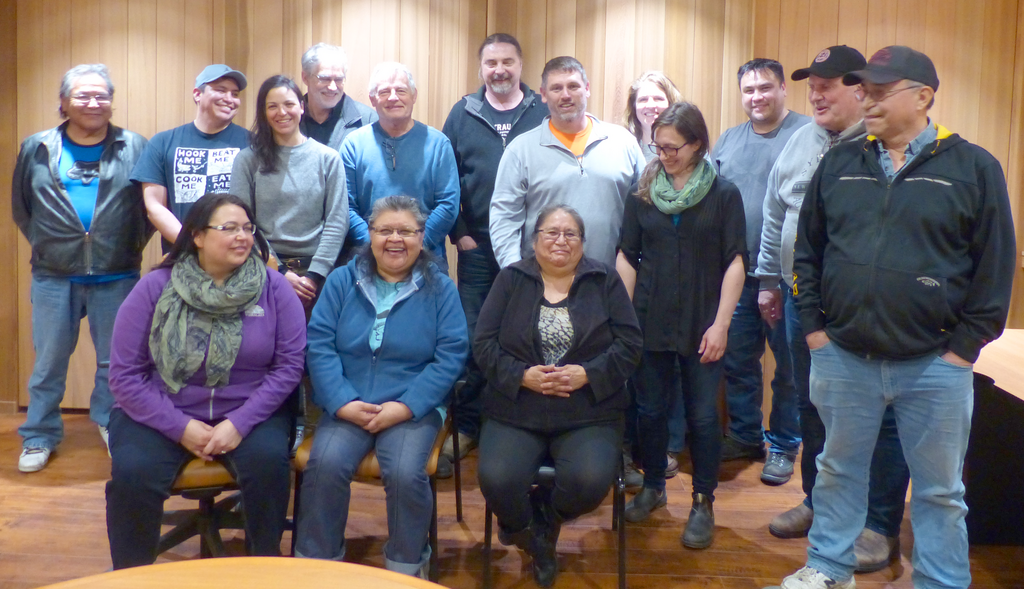
The Squamish Nation is based in BC’s lower mainland, in West Vancouver, North Vancouver, and Squamish, BC. It includes 26 First Nations reserves around the Capilano River, Mosquito Creek, and Seymour River on the north shore of Burrard Inlet in North Vancouver, along the Squamish River, and in Gibsons and Port Mellon in Howe Sound.
One of Squamish Nation’s schools, Capilano Littlest Ones, brings together 130 Indigenous and non-Indigenous students in the Norgate area of urban North Vancouver. The school and its library bring together Indigenous and non-indigenous citizens, to break down social barriers, build bridges across cultures, and re-establish positive relationships. Capilano Littlest Ones is a community school under the auspices of North Vancouver School District.
About the library
Write to Read BC installed a library in Capilano Littlest Ones Xwemelch’stn School. Its sponsors included the Rotary Club of West Vancouver Sunrise.
Metlakatla is a small, west-coast village at Metlakatla Pass near Prince Rupert, BC.
Metlakatla village is a progressive community, 5 km north of Prince Rupert on an ancient site. For thousands of years, the Metlakatla people have lived there. Metlakatla means saltwater pass in Sm’algyax, the language of the Coast Ts’msyen (Tsimshian) people.
Metlakatla honour their history on the land. Its council oversees a number of services in the community to ensure members have the best quality of life possible, including access to healthcare, education, recreation, and social development.
About the library
This is the 10th library Write to Read BC installed, in partnership with the community. Its sponsors included Camera Buildings and Coquitlam Chrysler (Now Journey Chrysler Dodge Jeep Ram).
The Lheidli T’enneh Band, previously the Fort George Indian Band, are Dakelh and Carrier people who lived where the Nechako River joins the Fraser River, and traditionally included the city of Prince George, BC. Lheidli T’enneh means “The People from the Confluence of the Two Rivers.
The band used temporary and seasonal settlements across their territory, and archeological evidence shows fishing camps along the Nechako and Fraser rivers as well as in the Beaverly area. The Lheidli T’enneh did not have permanent settlements in what is modern day Prince George until the 1820s arrival of the Hudson’s Bay Company post, Fort George, after which they also began keeping gardens.
The band government focuses on:
Natural resources and stewardship, including hunting permits, lands, fisheries, and related laws.
Community services, including health, family development, employment and training, social assistance, and education.
Engineering and operations, including ancient forest enhancement, infrastructure asset management, housing, IT, and water treatment.
The community also has an Elders society whose purpose is to protect and encourage Lheidli T’enneh traditions, language, and culture through access and education.
About the library
In a partnership, Write to Read BC and the Lheidli T’enneh Band are designing a library. As the project continues, the library may be installed in 2025 or 2026.
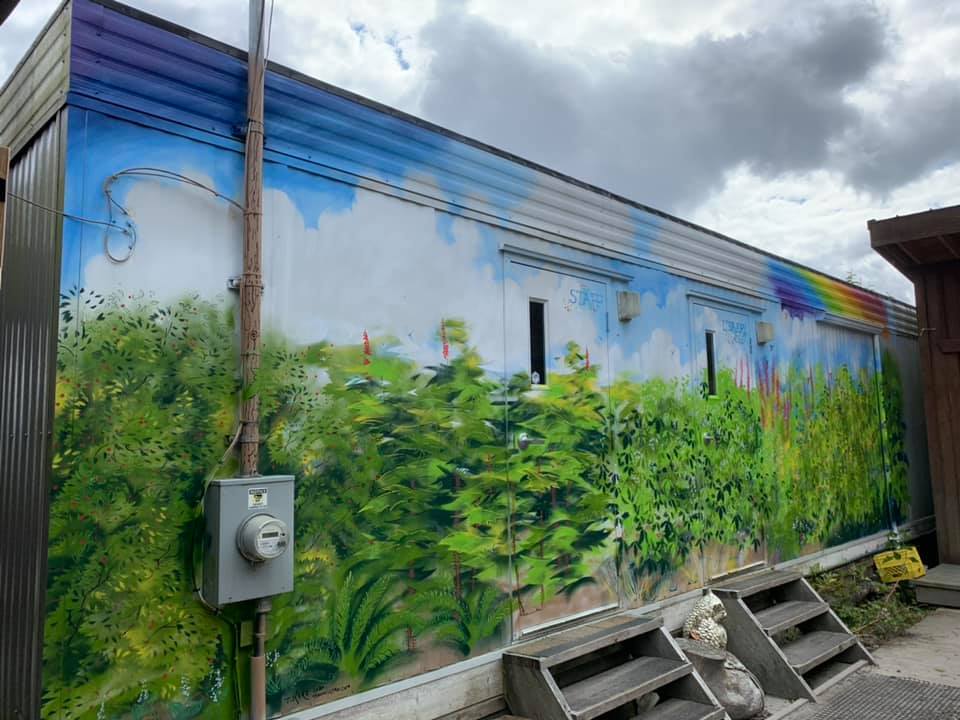
Need to brighten up your cloudy day? Stop by our Bella Bella library/office and check out this beautiful new mural by Thomas Kero! Photos don’t do it justice. There are so many hidden creatures and special features nestled into the summertime foliage.
A mural painted on the Bella Bella library. Kero wants the town to be as beautiful as the surrounding landscape.
Xeni Gwet’in First Nations Government, part of the Tŝilhqot’in Nation, is about 200 km west of Williams Lake, BC. Tŝilhqot’in is often translated as People of the River, or People of the Blue Water.
About one third of the Xeni Gwet’in community’s 400 members lives on their traditional territory. The people in Xeni Gwet’in maintain their land and their system of governance, as they always have. The land is a unique ecosystem, mountainous, crossed by glacial waterways and covered in forest. The government works towards community self-governance, with an emphasis on unity, respect, trust, and pride in the Tsilhqot’in heritage, language, and culture. The goals of Xeni Gwet’in government are to conserve the natural resources of its territory, keep the ecosystem healthy, in an economically sustainable way.
The band runs the local roads yard as well as a gas-bar, and built a housing subdivision with its own electrical grid, since the community is not connected to the main BC Hydro grid. The band manages its health program, and the local school serves Kindergarten to Grade 8 in three classrooms. Its teachers are long-term residents.
About the library
In partnership with the community, Write to Read BC discussed the vision for a library, which was then designed and constructed.
Some time ago, the Kwadacha indigenous community in Fort Ware approached Write to Read BC about a library. We can now get a project started with them.
This is because two Rotary Clubs are willing to partner with the community.
Fort Ware is north of Williston Lake, which is a substantial logistical challenge. No provincial highways reach the community, but a logging road extends north from the Prince George region.
The CBC’s flagship television news program The National recently featured an 8-minute broadcast about the Write to Read BC project, which was broadcast across Canada. CBC aboriginal affairs reporter Duncan McCue, based in Vancouver, visited a native library in Malahat on Vancouver Island and spoke with several members of the project. Chief Michael Harry says he was pleased the library was built entirely from donated services and fundraising, without any federal or provincial support.
“It’s showed the government that we can do this without them, and that we want to thrive,” said Harry. “But more importantly, we want to create relationships with external communities surrounding us.” The Malahat Kwunew Kwasun Cultural Resource Centre will celebrate its grand opening this summer.
The CBC show mainly told the story of Write to Read BC founders, former lieutenant-governor Steven Point and his former aide de camp Bob Blacker. Point ended his term as lieutenant-governor in 2012 and was reappointed as a provincial court judge, so in his current position he cannot continue as spokesperson. But he’s thrilled to see Write to Read BC continue to grow.
“It’s connecting these folks, breaking down barriers that should never have been there. And they’re coming out to the communities for the first time, saying, ‘We want to help,’” said Point.
Point’s successor, lieutenant-governor of BC Judith Guichon, has enthusiastically endorsed the project since she took over the post. Write to Read BC has installed and opened six libraries, with six more on the way. To date, 30,000 books have been donated.
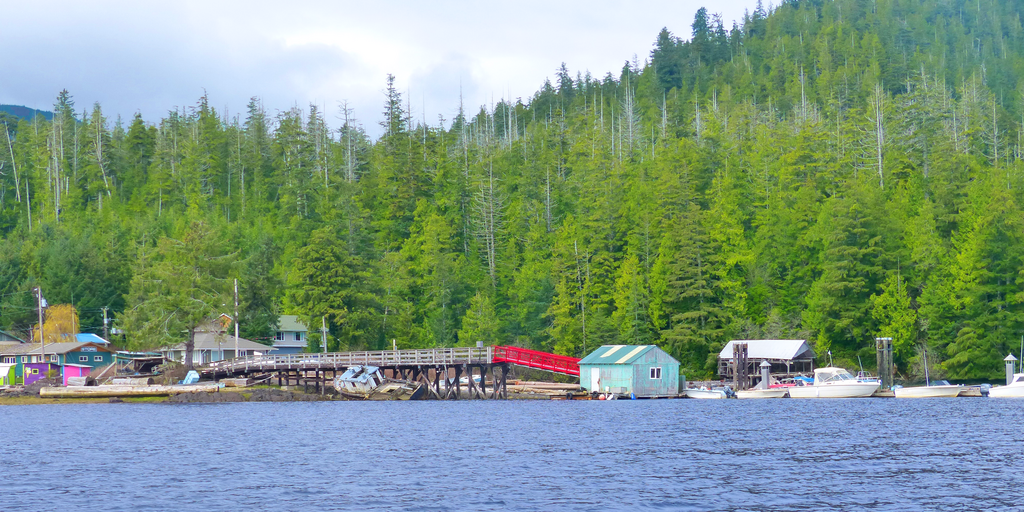
Write to Read BC’s design response team visited Kyuquot on northwest Vancouver Island. This visit had to take place when the weather was good, as the road from Campbell River to Fair Harbour ferry is busy with logging trucks, and feels safer when dry. They were received by a band committee including Chief Peter Hanson, committee member Daisy Hanson, band administrator Cynthia Blackstone, project coordinator Russell Hanson, and others.
A view of Kyquot village when arriving by ferry from Fair Harbour.
The Write to Read BC team included co-lead Bob Blacker, architect Scott Kemp, architect intern Kelly Bapty, mechanical engineer Mike Herrold, structural engineer Melissa Kindratsky, big log builder Steve Lawrence, filmmaker Michael McCarthy, financial guru Lawrence Lewis, and master carver Moi Sutherland. During the visit, they stayed with Susan Plensky and her husband Skip.
Together, the visitors and band committee started the planning process for a library. This concept quickly grew into a community centre that contains a library—in a building that will be built onsite rather than prebuilt and shipped there.
This ambitious work was named The Big Project.
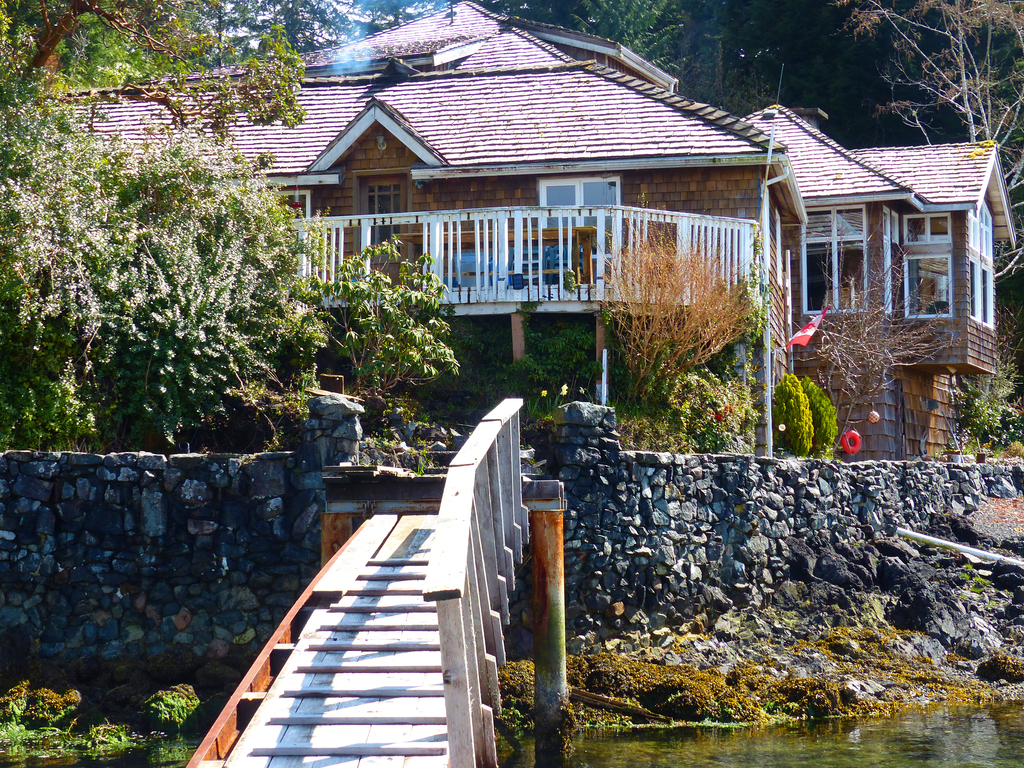
A tidal dock that leads up to a reinforced seawall in Kyquot village.
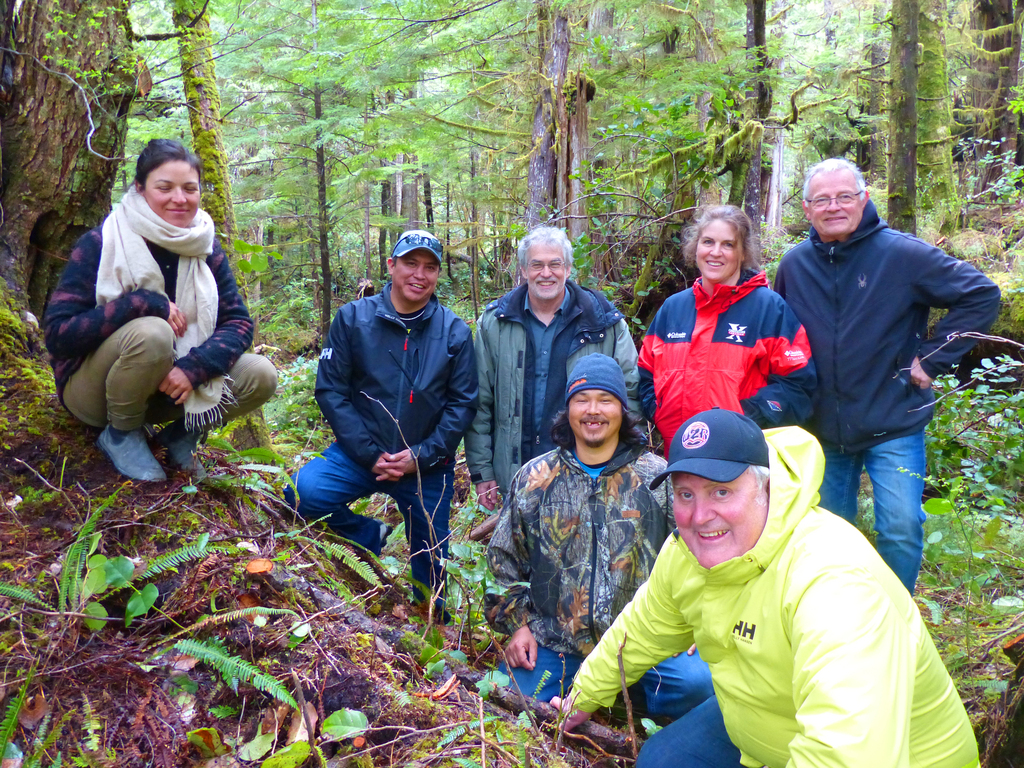
The visitors and band committee of residents toured the village, and together decided the original site for the planned library was too close to sea level and at threat from any tsunami. To find an alternative site, the entire team hiked up the hill past the school to the site of a planned neighbourhood. The engineers wanted an up-close inspection, so the entire team bushwhacked into rarely-visited forest, where the biomass underneath was 3 m deep. This is the site they found.
Site of the future Big Project, uphill from Kyquot village.
Steve Lawrence, a big log builder, announced the site was perfect to harvest the timber needed for the community centre. The village will install a mill on the site, to cut the logs themselves. The community will also consider getting involved in the construction, which removes the need to bring in, house, feed, and pay a full construction crew for the length of the project.
Community involvement
The band committee heard that the entire village must be actively involved in planning and fundraising from the very beginning of the project. If the village does not pledge enough support and primary funding, The Big Project will not proceed. Fundraising will require a wide variety of events, grants, and donations from the public and businesses.
Financial planner Lawrence Lewis explained the costs in detail. The scope and success of the project depends on how much the community gets involved. Hiring an outside construction crew is not part of the estimate, which is why the village needs to consider taking on that work.
Working together: the band committee and Write to Read BC’s design resposne team in Kyquot village.
Design and construction
The Write to Read BC volunteers left the village of Kyuquot satisfied the band has the skills and experience to take on The Big Project. The design response team prepared and published a draft design of a community centre that has a library with Internet connections for its learning centre, a kitchen, meeting rooms for elders and youth, a museum, a gymnasium, and a day care centre.
After it’s revised and agreed, the design will be handed to Write to Read BC’s construction response team and library response team for the next stages of the project.
Write to Read BC withdrew its interest in receiving a building from the Municipality of Oak Bay, due to hidden costs. Our construction response team immediately identified a better financial option.
Instead, the Young Professionals of Nanaimo have decided that, for the Snunymuxw library, they will build the same solution we used for the Xeni Gwet’in library. They have already raised $25,000 towards building and met with Write to Read BC’s architect, Scott Kemp, about the design.
This BC community worked very hard to build their school, but unfortunately did not have funding for a library. Write to Read BC will visit the Stz’uminus school and meet with the principal, Tim Harris, and see what we can do.