Tag: partnerships

  • Study: Libraries serve Indigenous children and adults alike

    The preview of an upcoming study reports adults in isolated, Indigenous communities use libraries as much or more than children. The study is assessing at the long-term impact of Indigenous-led libraries installed in partnership with Write to Read BC.

    This research was made possible with Simon Fraser University’s CERi funding. The study’s Indigenous researcher gathered data from isolated communities that installed an indigenous-led library with us. The research was conducted in 2025, and the report will be published in spring 2026.

    School libraries

    Many communities installed a library connected to their local school. Obviously, these spaces get significant use by children.

    However, adults also want to use reading materials and programs about culture and language. That’s why some schools welcome adults, too. For example, Nisaika Kumtuks school in Nanaimo set specific hours for family members to use material in its library.

    Rather than in a school, many communities installed books and computers a separate community facility. Both children and adults can use these, but they are harder to fund, according to some study participants. “There is funding for libraries attached to schools, but not necessarily for community-specific libraries,” the study’s author reports.

    Nevertheless, over the past 15 years most libraries installed with Write to Read BC are community libraries.

    Community libraries

    In addition to support for reading—including reading about Indigenous cultures and languages—these spaces are also community-building hubs. This is one of the benefits that attracts community members. Often, libraries are a showcase of local culture and history. One participant mentioned plans to create a museum alongside the library.

    In addition to these adult-oriented activities, community libraries also help educate children. Since 20% of the youth living on reserves attend school online, community libraries often have a role in childhood education.

    Unfortunately, older libraries in the Write to Read BC program did not all include computers and high-speed Internet. Some participants told the researcher that “a designated space” for online learners would be “a helpful addition to their community.” This would benefit adults and children alike.

    Findings from the CERi study were first presented in October, 2025.

    Research on the impact of Indigenous-led libraries installed together with Write to Read BC in isolated BC communities.
  • Assessing the impact of Write to Read BC

    An independent researcher is evaluating the long-term impacts and community perspectives of the Write to Read BC Project, at its request. Working closely with Indigenous leaders, educators, and community members, this research “will culminate in an assessment report that will guide the re-framing and Indigenization of the Write to Read BC Project.”

    The assessment is provided by a program at Simon Fraser University that helps SFU graduate students collaborate with non-profit groups and community groups. The program supports research projects that provide plain-language answers to community-driven research questions at low or no cost to the community partner.

    The Write to Read BC study will focus on

    • Community collaboration and data collection.
    • Literature and media review.
    • Data analysis and reporting.

    The research takes place in 2025. Next, a prepublication will be available for review. Finally, the official report will be published in spring 2026.

    Community collaboration and data collection

    The study will:

    • collaborate with Indigenous leaders, educators, and community members to gather perspectives on the impact of active and inactive learning centres.
    • conduct interviews, facilitate protocol-guided information-sharing sessions, and ensure respectful, ethical data collection.
    • assist in developing “case stories” from selected communities, ensuring informed consent and cultural sensitivity.
    • document and organize qualitative data to inform the final project report and analysis.

    Literature and media review

    The study will:

    • conduct a literature review focusing on the intersections of Indigenous knowledge systems and colonial education practices.
    • review and summarize “grey literature” and media related to the Write to Read BC project, including speeches, audio/video recordings, and planning documents.
    • gather and analyse quantitative data on educational outcomes (such as Kindergarten to Grade 12 graduation rates, post-secondary enrolment) in communities with Write to Read BC centres.
    • identify gaps in the literature or data and recommend additional resources to address these gaps.

    Data analysis and reporting

    The study will:

    • analyse qualitative and quantitative data to understand changes in community engagement, cultural connectedness, language revitalization, and educational impacts associated with Write to Read BC learning centres.
    • assist in preparing interim reports, summaries, and visual presentations to share findings with project stakeholders.
    • draft a final report, weaving Indigenous knowledge, community insights, and statistical data into a cohesive narrative.
    • assist in developing recommendations for future iterations of Write to Read BC and strategies to support its ongoing sustainability and alignment with Indigenous sovereignty.
    Research on the impact of Indigenous-led libraries installed together with Write to Read BC in isolated BC communities.
  • Tsawassen

    About the community

    The Tsawwassen First Nation is in greater Vancouver, in BC’s lower mainland. Its name means “land facing the sea”. Traditionally, its lands covered a what is now Pitt Meadows, New Westminster, and several gulf islands off the mainland’s west coast. It has lands close to the south arm of the Fraser River, and just north of the border with the USA at Point Roberts.

    Tsawassen First Nation has a youth centre on site that includes a gymnasium, weight room, art room, teen lounge, and teaching kitchen. It has areas for music, dance, and media that allow for scheduled and drop-in classes. There is after-school care for young children.

    The centre also has a library.

    About the library

    Write to Read BC installed the library in partnership with the Tsawwassen First Nation Youth Centre.

  • Aboriginal Mother Centre

    About the organisation

    Aboriginal Mother Centre offers housing in Vancouver, BC, for mothers and their young children, who are at risk of homelessness or child welfare intervention. The program offers suites for mothers and children under the age of nine.

    The program focuses on mothers giving back to their community, for example by helping with the Elders program by serving food, cleaning up tables, distributing food to take home, and engaging with Elders.

    Aboriginal Mother Centre also offers family-wellness programs for mothers to enhance their skills and abilities as parents, and help them on their life journeys. Each week, the centre also offers parenting workshops, housing- and resources workshops, life-skills workshops and self-care workshops.

    About the library

    Write to Read BC placed a library in the Aboriginal Mothers Centre. The library’s sponsors included the Rotary Club of Whistler Millennium.

  • Gitsegukla

    About the community

    Gitsegukla is is on the southeast side of the Skeena River adjacent to the Kitseguecla River mouth, in west-central BC’s Skeena region. This indigenous community is about 100 km northwest of Smithers and about 110 km northeast of Terrace.

    About the library

    Write to Read BC installed its 19th library here, in the Gitsegukla elementary school. Its sponsors included the Rotary Club of Terrace-Skeena Valley, the Rotary Club of Peachland, and the Jack Gin Family Foundation.

    Write to Read BC volunteers were challenged by this library. The need to avoid spreading COVID-19, the work took place, during a school holiday, when students were offsite. Out-of-town volunteers who brought shelving, furniture, books, and computer equipment did not socialise or stay with with community members.

    This library had a positive impact on the community.

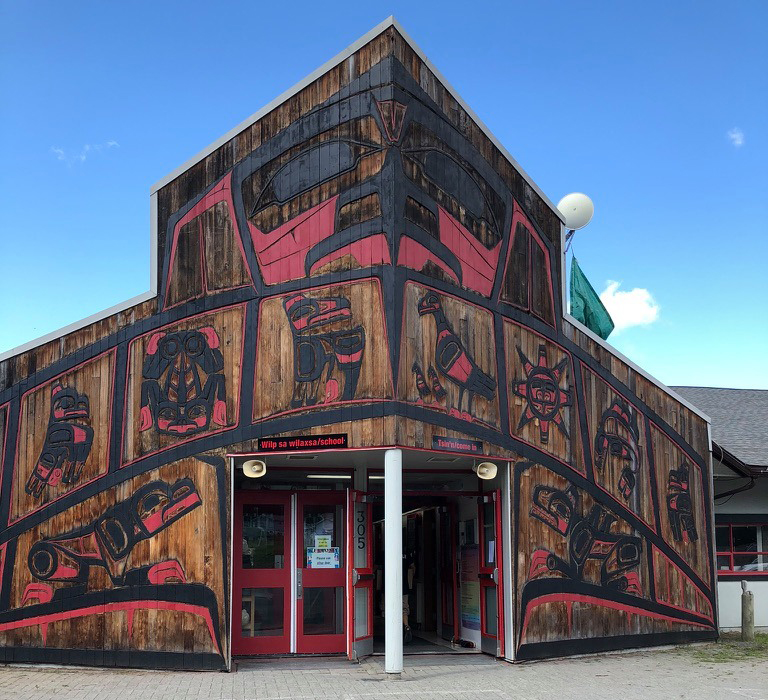
    The entrance of Gitsegukla school and library.
    A literacy-focused addition to the community school.
  • Ahousaht

    About the community

    Ahousaht First Nation is a coastal community on Vancouver Island in BC. It includes much of Clayoquot Sound, and is the largest First Nation on the west coast of Vancouver Island by population. It has 2,400 members.

    Ahousaht First Nation’s core values are to respect one another, teach one another, care for one another, and help one another​, and to know that everything is one—everything is interconnected. The community also publishes a dictionary of Ahousaht words.

    About the library

    Write to Read BC’s 15th library was installed here. Its sponsors included the Rotary Club of Vancouver Arbutus, and the Rotary Club of Steveston.

  • Tsay Keh Dene

    About the community

    The Tsay Keh Dene First Nation is a Sekani band in the Omineca region of northern BC’s interior. Its territories, settlements, and reserves are around Williston, about 550 kilometres north of Prince George.

    The people of Tsay Keh Dene hunted, trapped, fished, gathered food and herbs, and traditionally lived on this territory in the Rocky Mountain Trench. Tsay Keh Dene means People of the Mountain.

    The community is vibrant, created through hard work and commitment to its values, beliefs, and principles. This includes striving for sustainable growth and improving quality of life of its members. It does this through sound governance and responsible growth.

    About the library

    In partnership with the community Write to Read BC installed its 13th library here. Its sponsors included Rotary Club of Prince George Yellowhead, and Britco (now Boxx Modular).

  • Nooaitch

    About the community

    Nooaitch First Nation is in the southern interior region of BC, with its reserve community and offices in Merritt. The main urban centre is in the Nicola Country region, between the Lower Mainland and Kamloops.

    The Nooaitch First Nation reserve has a population of about 250 people.

    Economically, forestry is important to this community. In response to pine beetle infestation, in 2007 the band agreed to harvest 20,000 m³ of timber annually over a 5 years, in its traditional territory.

    About the library

    Nooaitch First Nation’s vision for its library included video-conferencing. As a result, other partners donated computers and screens, to make that vision a reality. This library can offer remote participation in courses and conferences, in its learning centre. In partnership with the community, this was the 12th library Write to Read BC installed. Sponsors included Rotary Club of Merritt, and Britco Structures (now Boxx Modular).

  • Metlakatla

    About the community

    Metlakatla is a small, west-coast village at Metlakatla Pass near Prince Rupert, BC.

    Metlakatla village is a progressive community, 5 km north of Prince Rupert on an ancient site. For thousands of years, the Metlakatla people have lived there. Metlakatla means saltwater pass in Sm’algyax, the language of the Coast Ts’msyen (Tsimshian) people.

    Metlakatla honour their history on the land. Its council oversees a number of services in the community to ensure members have the best quality of life possible, including access to healthcare, education, recreation, and social development.

    About the library

    This is the 10th library Write to Read BC installed, in partnership with the community. Its sponsors included Camera Buildings and Coquitlam Chrysler (Now Journey Chrysler Dodge Jeep Ram).

  • Ditidaht

    About the community

    The Ditidaht First Nation is a band government on southern Vancouver Island in British Columbia, Canada. The government has 17 reserve lands: Ahuk, Tsuquanah, Wyah, Clo-oose, Cheewat, Sarque, Carmanah, Iktuksasuk, Hobitan, Oyees, Doobah, Malachan, Opatseeah, Wokitsas, Chuchummisapo, and Saouk.

    Several of these lands are part of the newly established Pacific Rim National Park and can be reached on foot by the West Coast Trail. The land, waters, resources, and environment have always been the source of life, culture, and spirituality of the Ditidaht People.

    Ditidaht First Nation is governed by an elected Chief and councillors. Ditidaht Economic Development Corporation manages economic development the nation.

    About the library

    Write to Read BC installed its ninth library here, in partnership with the community. The Rotary Club of North Delta was a sponsor of this library.