Leaders of Lheidli T’enneh First Nation, educators, and Write to Read BC volunteers have discussed the community’s vision for an indigenous-led library. A library offers support for programs that interest the community.
Also, the library’s collection will represent Indigenous communities.
The Lheidli T’enneh Band, previously the Fort George Indian Band, are Dakelh and Carrier people who lived where the Nechako River joins the Fraser River, and traditionally included the city of Prince George, BC. Lheidli T’enneh means “The People from the Confluence of the Two Rivers.
The band used temporary and seasonal settlements across their territory, and archeological evidence shows fishing camps along the Nechako and Fraser rivers as well as in the Beaverly area. The Lheidli T’enneh did not have permanent settlements in what is modern day Prince George until the 1820s arrival of the Hudson’s Bay Company post, Fort George, after which they also began keeping gardens.
The band government focuses on:
Natural resources and stewardship, including hunting permits, lands, fisheries, and related laws.
Community services, including health, family development, employment and training, social assistance, and education.
Engineering and operations, including ancient forest enhancement, infrastructure asset management, housing, IT, and water treatment.
The community also has an Elders society whose purpose is to protect and encourage Lheidli T’enneh traditions, language, and culture through access and education.
About the library
In a partnership, Write to Read BC and the Lheidli T’enneh Band are designing a library. As the project continues, the library may be installed in 2025 or 2026.
The Gitanmaax Band are Gitxsan people live where the Skeena and Bulkley rivers meet, in north-western BC near Hazelton. Gitanmaax was the name of the winter village, which became the current reserve. Gitanmaax means People who Fish by Torchlight.
The Gitanmaax Band currently has about 800 members living in the community, and about twice as many more living elsewhere.
Every 2 years, members elect a Chief and 12 council members. Each council member is appointed a portfolio of services that the band administration delivers to the community:
Community-member services, including education, social development, child and youth wellbeing, and health.
Infrastructure and community services, including lands, housing, public works, and public safety.
Professional services, including administration, finance, economic development, band membership, legal counsel, and company management.
About the library
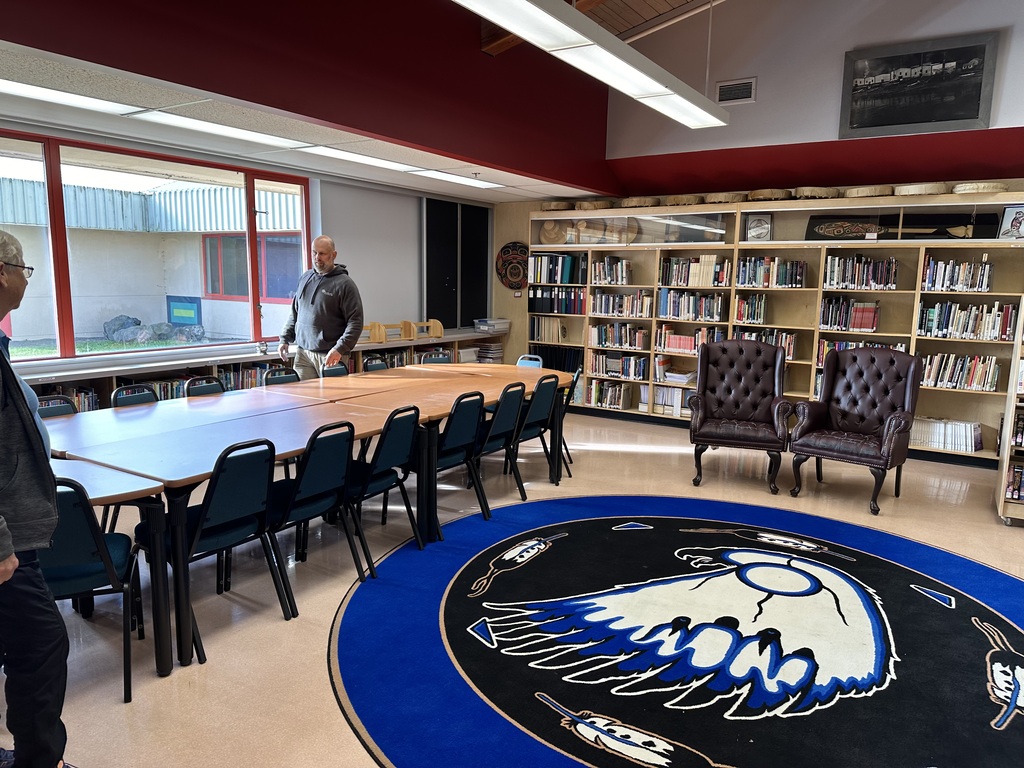
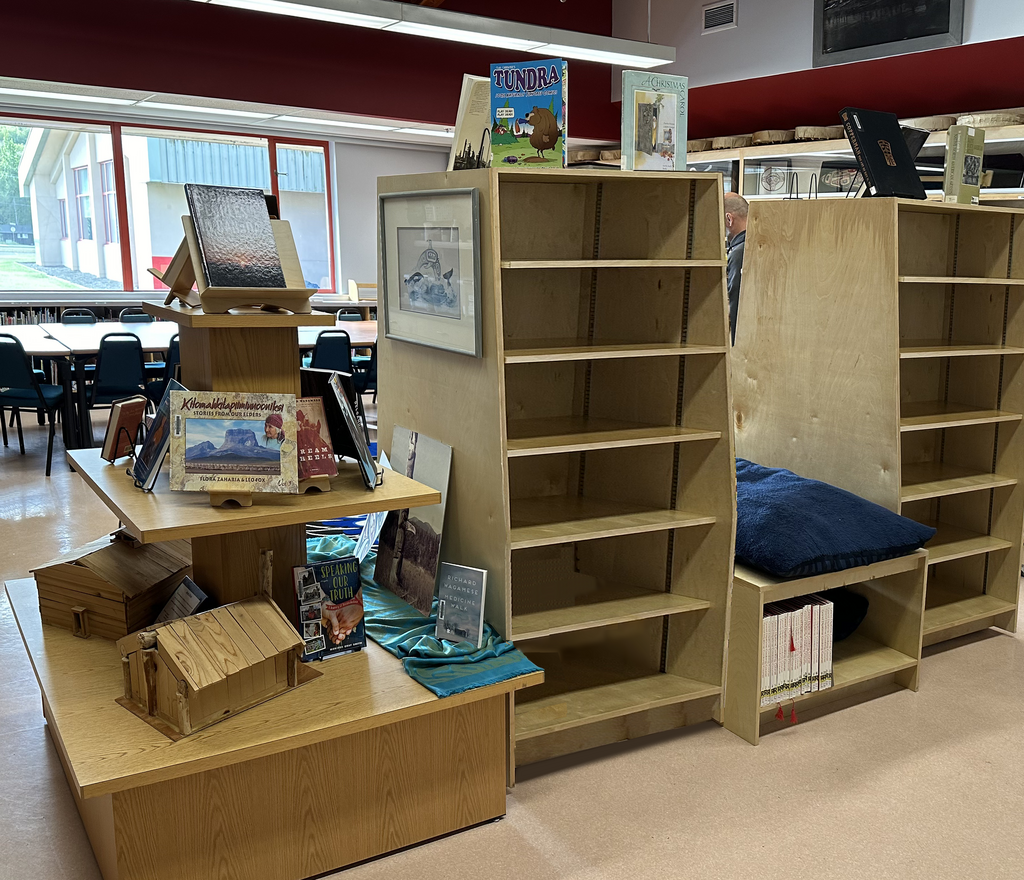
Gitanmaax installed a library in its Hazelton First Nation Resource Centre. The community and council did this in collaboration and partnership with Write to Read BC. The library includes display cases for important cultural objects, wooden models of traditional Indigenous housing, and books about a range of Indigenous cultures and lands.
The newly installed books and important cultural objects.
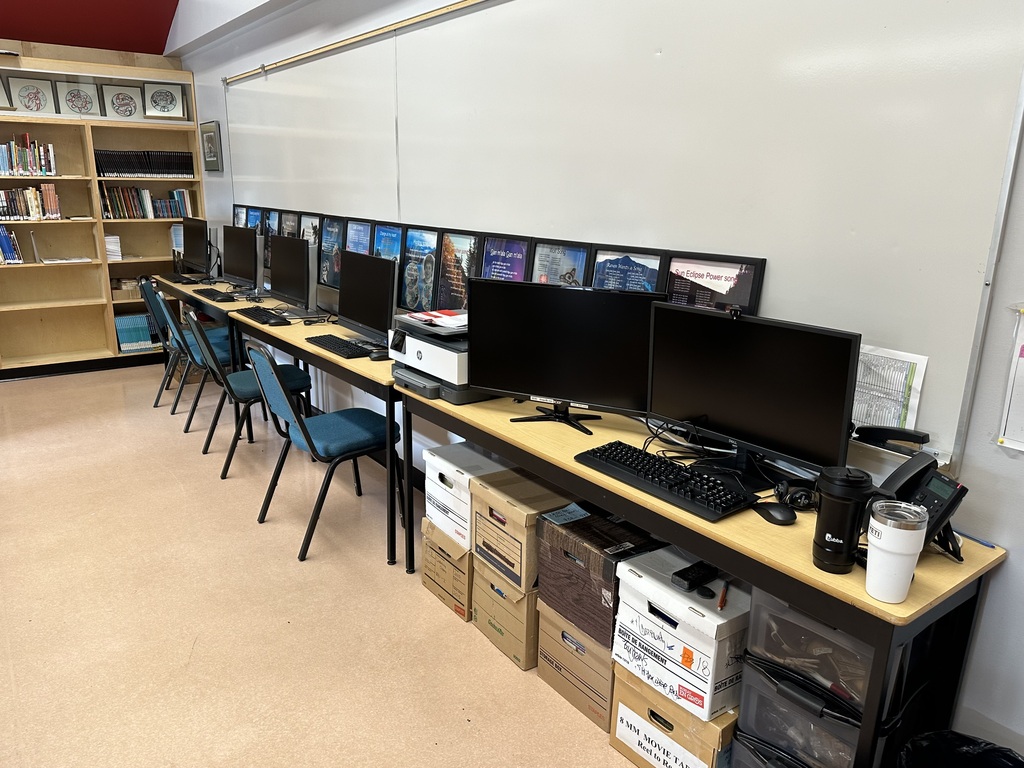
The library has tables and seating for working and meeting. Along one wall, it has computers and screens to allow remote attendance at online courses and conferences, in its learning centre.
Four workstations and a printer, with the capacity to grow the library’s learning centre.
Near the village of Hazelton, Write to Read BC volunteers recently delivered custom shelving required for the community’s school library. The shelves will also display important cultural objects, in both enclosed and open displays.
New shelving, to be filled with books by the library response team. On the left is an open display case that shows framed historical photos and wooden models of traditional Indigenous housing.
The school’s plan is nearing completion. The shelves were built for the library by Nanaimo Correctional Centre.
This is the 23rd library the Write to Read BC project will install in isolated communities across BC, in partnership with the community.
The Nlaka’pamux Nation has many bands, whose traditional territory includes parts of the Thomson River, Fraser Canyon in BC and south into the North Cascades region of the USA. The Nation is constructing a multipurpose community centre in Kumsheen, or Lytton.
The centre will include spaces for childcare, youth programming, cultural gatherings and celebrations, and for knowledge exchange and language revitalization. This project will also include a commercial teaching kitchen, a community café, and an Elders lounge. The building is designed with a strong focus on sustainability, cultural preservation, and climate resilience.
About the library
In 2027, Write to Read BC plans to install a reading room in partnership with the Nlaka’pamux Nation.
Write to Read BC volunteer Margaret Fletcher will speak to the Community-Led interest group of BC Library Association, or BCLA. Fletcher will discuss how Write to Read BC partners on projects in isolated communities across BC. She’ll also talk about the impact these projects have on social barriers and reinforcing community culture. This includes the installation of Internet-connected computers that provide remote access to courses and conferences through these learning centres.
The association’s interest group meets quarterly, with its next meeting in December.
The BCLA Community-Led interest group is about a community-led service approach, which consists of community consultation, needs assessments, metrics, and ongoing monitoring of services and programs. The interest group’s members want to connect and collaborate with community members to better support their needs.
At its core, the community-led model is about reducing or eliminating barriers to library services and programs. Another key factor to the community-led approach is staff training and development within the communities.
Write to Read BC has been selected to participate in a panel discussion at the conference for Libraries, Archives and Museums Nova Scotia (LAMNS). The panel will discuss its partnerships with isolated BC communities to install indigenous-led libraries.
The panel takes place on Friday, October 22, and includes our co-lead Bob Blacker, co-lead Dr Shirley-Pat Gale, and volunteers Louise Ormerod, Sarah Dupont, and Gordon Yusko.
The conference theme is Moving Forward Together: Collaboration and innovation to meet changing needs. The theme highlights the resilience of the three sectors—libraries, archives, and museums—as they developed ways to collaborate with communities from a distance due to Covid-19.
Several members of isolated BC communities attended a virtual conference about Indigenous communities. The conference, sponsored by Libraries, Archives and Museums Nova Scotia, included breakout sessions.
During the breakout sessions, members discussed their experience with Write to Read BC, and made new connections with people from Indigenous communities in other provinces.
Virtual conferences don’t just give remote attendees access to people in other communities. They expose attendees to other ideas and perspectives, and to a broad body of knowledge and potential for collaboration.
Usborne Books at Home is funding $1,000 each for Write to Read BC’s current library projects. A discussion over the summer led to Usborne’s support for the libraries of Gitsegukla, Tsideldel, and Heiltsuk first nations.
With each $1,000 order, Usborne will also provide free shipping and a 25% credit for additional purchases. This helps Write to Read BC make cash donations go even further. Our volunteer team thanks Usborne and its local representative, Louise Toews, for their generosity.
Write to read BC volunteer Wendy Brundage visited Gitsegukla in early September, and will follow up with the Elementary School’s principal Louise Ormerod to consult on the school’s book choices.
Usborne is based in southern Ontario, and has been in business for over 50 years. It’s a past winner of Children’s Book Publisher of the Year. Its mission is to help spread a love of literacy to kids and their families across Canada.
After a long drive from Prince George, the installation team arrived in Gitsegukla at 2:45pm on a Tuesday, ready to install a library for the school and community.
The installation took 3 days, while the school was closed for holidays. To comply with COVID-19 restrictions, the out-of-town volunteers obviously could not socialise or stay with community members. The efforts of the volunteers, including members of Write to Read BC’s library response team, were planned from start to finish.
A literacy-focused addition to the community.
On arrival, the library response team swung into action, with the school staff and principal Louise Ormerod. Once the furniture was unloaded, the library response team started organizing the layout of the learning centre, with its internet connection that allows remote attendance at courses and conferences..
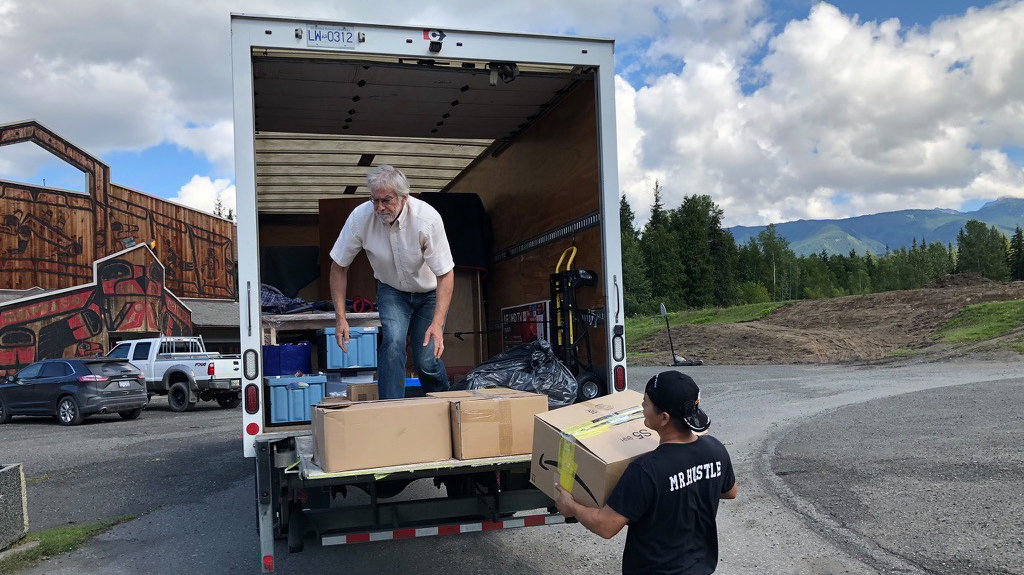
Volunteers unloading a delivery of library books.
Fetching sponsors
On Day 1, the team started early and progressed well. Total Support Services Chief executive officer Chris Gillen made a “quick” 3-hour return trip to Terrace to fetch more shelving tabs and an HDMI cable for the TV.
Chris Gillen of Total Support helps troubleshoot the learning centre’s computers at no cost.
How Total Support Services joined Write to Read BC
For a Victoria-Harbourside Rotary Club meeting a few weeks before the Gitsegukla library were installed, Write to Read BC co-lead Bob Blacker gave a presentation about the program, by video call. One of the audience members mentioned that her son-in-law was working with First Nations to provide computers, IT solutions, and training. A few days later Bob received a call from Chris at Total Support, expressing interest. As a result of this connection, Write to Read BC now has a supplier of computers and related hardware needed for learning centres. In addition, Total Support will, at no cost to the libraries—provide online support for any computer problems that surface. This has been huge for Write to Read BC, as support for computers has always been a concern; now we do not have to worry about that.
After 3 days of hard work, the Write to Read BC team, along with principal Ormerod and her staff, completed Write to Read’s very first “version 3” learning centre.
We had some hiccups over the three days, which is to be expected, but we were able to prevail. The new library and resource centre looks great.
Masks off for the group photo: The satisfied team that installed the library and learning centre.
Preceded by planning and design
The team leads recalled the process that led to the installation of this library.
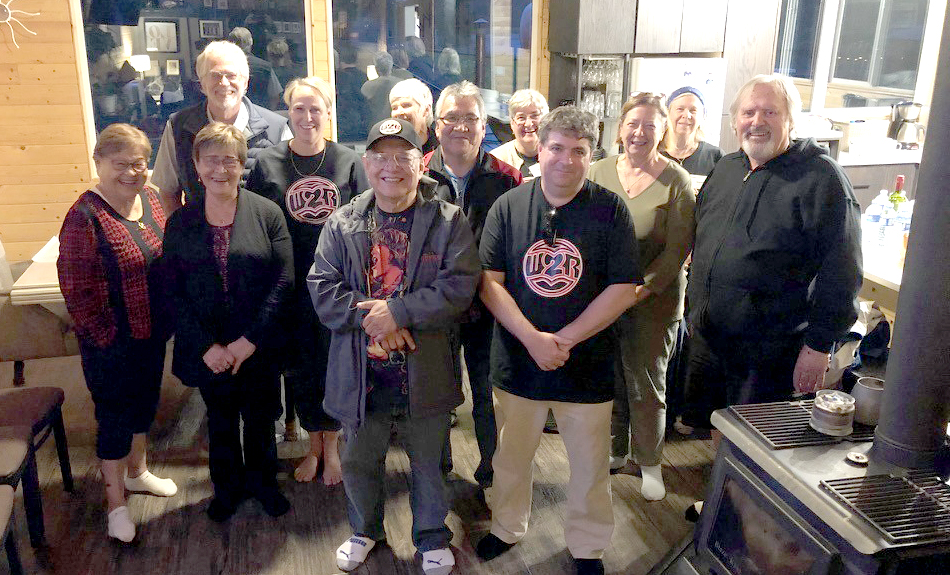
The Write to Read BC team met with Chief Willie and three council members, overlooking Princess Lake. This meeting allowed members of the team to chat with key members of the community. The evening ended with a handshake between Chief Willie and Write to Read BC team co-lead, Bob Blacker, cementing the agreement and the blossoming friendship and trust with Gitsegukla.
As one of the team members said: “This is what makes it all worth it.”
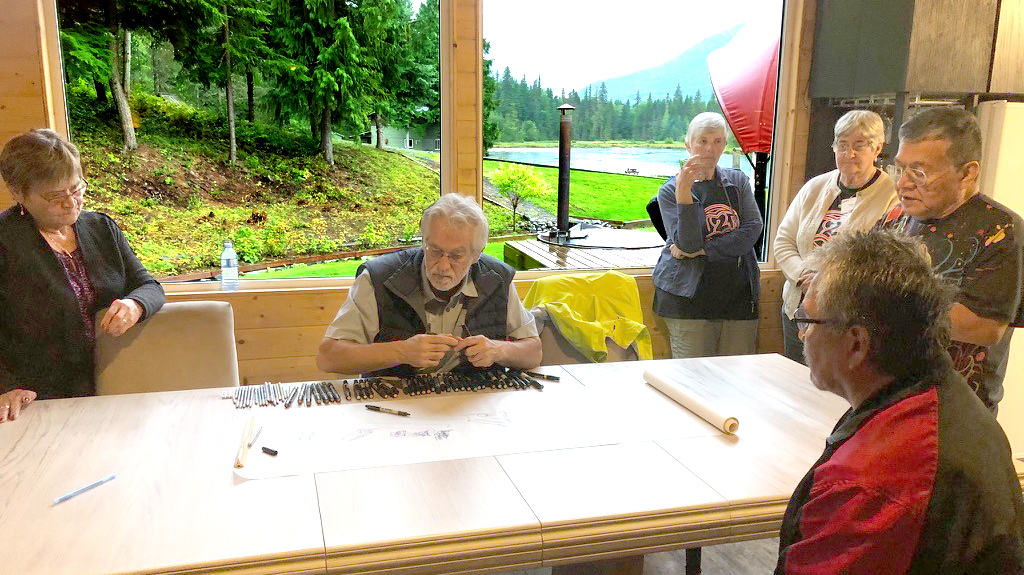
An earlier imagineering session: What does the community’ envision next?
The evening was topped off with an imagineering session, lead by design response team member, Scott Kemp. This was also a new experience for the Write to Read BC team.
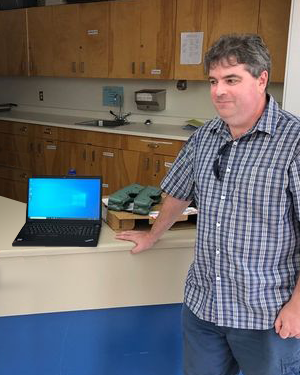
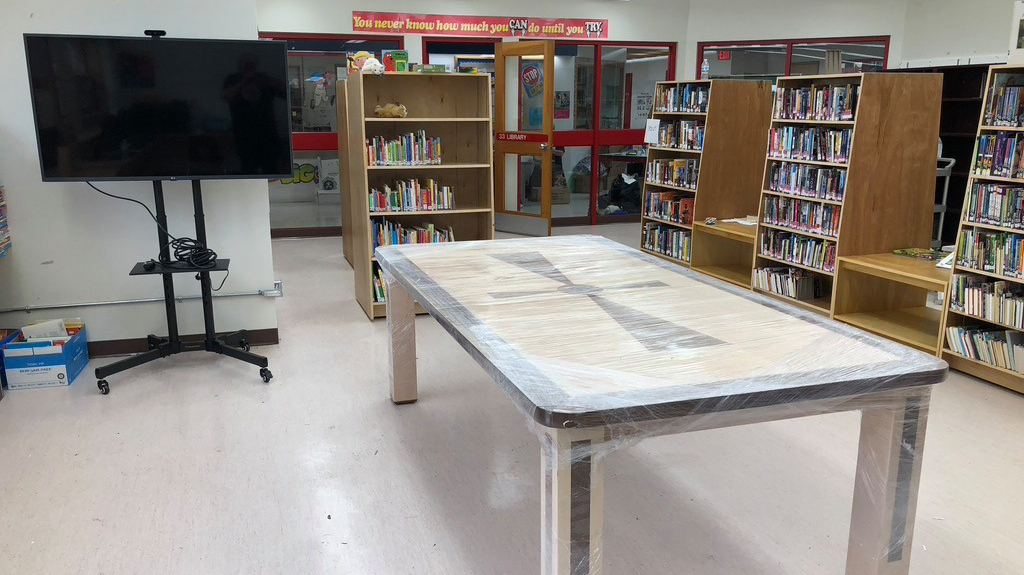
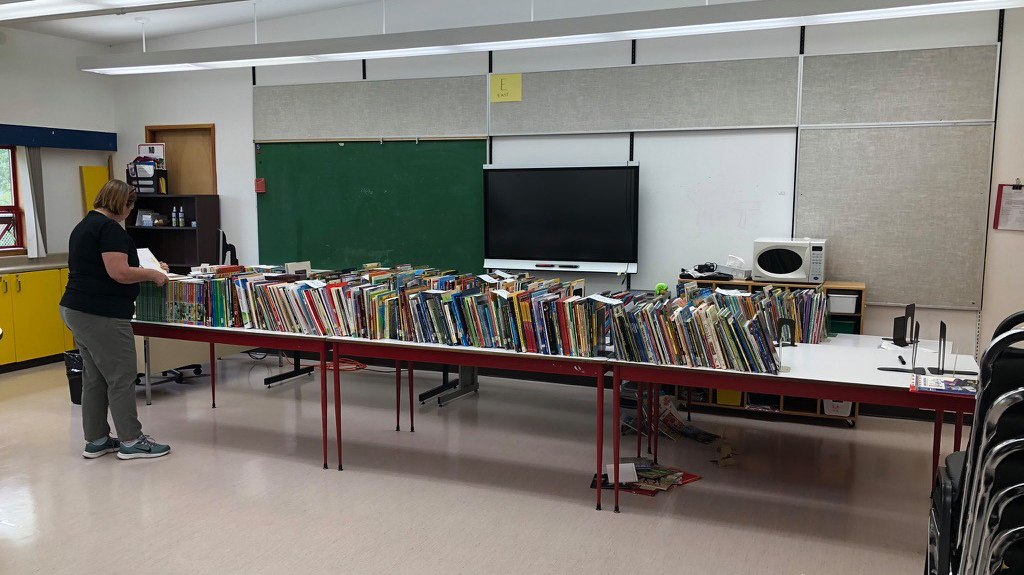
Key components of the learning centre: a large screen and a computer table.At this point still a warehouse of books, this room will soon be a classroom.