Category: Update

For minor updates of interest mainly to Write to Read BC teams, communities, and partners.

  • Conference attendees respond to Write to Read BC projects

    During a presentation about Indigenous BC libraries, attendees at 2026 BC Library Conference expressed interest and engaged with the panel of presenters. The conference is an annual event sponsored by BC Library Association.

    Panel shared a recently completed impact study of Write to Read BC’s collaborative projects with isolated Indigenous communities. After the presentation, the audience shared their own experiences as librarians. They also asked questions about process, to learn how to better serve indigenous readers in public libraries.

    Indigenous groups in public libraries

    One librarian noted that, in the past decade, public libraries in Canada have taken “hugely positive steps” by adding Indigenous books and content to their collections. The librarian said, “There’s a lot more programming focused on Indigenous history in Canada, including the horrible impact of Indian Residential Schools.”

    Others noted public libraries have actively recruited local Indigenous residents to be on their library boards.

    Another librarian said: “In our library we reach out to two local First Nation communities,” but added that this work has no government funding. “The province doesn’t really provide enough funding to cover the costs,” said the librarian.

    Members of the audience were not asked to identify themselves, so their comments aren’t attributed.

    Processing books

    One librarian asked about how Write to Read BC’s volunteers process books for Indigenous libraries.

    Indigenous libraries installed with Write to Read BC have new books from Indigenous publishing houses in their collection. They may also have a selection of other books. The Write To Read volunteers classify all these books using the Dewey Decimal system.

    A panel presenter noted that Indigenous youth in particular want to learn it. Knowing Dewey Decimal allows them to go into a public library knowing where to find the books they’re interested in.

    After the conference presentation, several librarians asked about volunteering with Write to Read BC to process books.

    Self-directed, Indigenous-led libraries

    Rather than support public libraries in making space for Indigenous readers, Write to Read BC takes a different approach. Its volunteers partner with isolated Indigenous communities to design and and install the library they themselves want.

    The focus has been on isolated communities that have no other library nearby. However, Write to Read BC has also partnered with Indigenous-led organizations and schools that want a library.

  • Promoting Write to Read BC with BCLA librarians

    Today, Write to Read BC announced the launch of this updated website to members of BC Library Association, or BCLA. That’s because BCLA members are well placed to promote the Write to Read BC project. The announcement also mentions an upcoming impact study about communities that have an indigenous-led library.

    BC Library Association logo.

    The role of librarians

    Librarians focus on advocacy, professional development, and support of intellectual freedom. BCLA members work to ensure everyone has equitable access to information, ideas, and works of the imagination. In contrast, Write to Read BC does the same by following the lead of First Nations communities.

    The announcement to BCLA

    This is what today’s announcement covered:

    On this National Day for Truth and Reconciliation it’s fitting to announce two things about the long-lasting Write to Read BC project.

    1. There is a new website, writetoreadbc.org.
    2. An impact study is in its final stages, with a report scheduled to be released in November.

    As many of you know, former lieutenant-governor of BC Steven Point envisioned and initiated this project during his time in that role between 2007 and 2012. A key partner in making the project a reality was his aide-de-camp at the time, Bob Blacker, an active member of a Rotary Club. CBC carried a story about this joint effort in May of 2014, as did various newspapers.

    Fast forward and along the way to 2025, Write to Read BC has collaborated with numerous Indigenous communities, under their leadership, to plan and install highly local libraries and learning centres. The new website documents these multiple efforts going back to 2011.

    Funding and support for the new website and the impact report was generously provided by SFU’s Main Street Research Shop. It collaborates with community partners, students, and faculty members to address community questions and concerns through research. The SFU Indigenous Student Centre has been equally generous in contributing in-kind support for a portion of the work schedule to co-supervise both the research and the web development.

  • Daylu Dena library books coming soon

    The co-leads of Write to Read BC plan to travel to Daylu Dena’s new library in early November 2025. They will deliver books and computers.

    The books will provide the indigenous focus that the community envisioned for its library.

    The computers and high-speed Internet connection will allow the library to offer remote access to online courses and conferences. Librarians typically refer to this as a learning centre.

  • Lheidli T’enneh Fort George library

    Leaders of Lheidli T’enneh First Nation, educators, and Write to Read BC volunteers have discussed the community’s vision for an indigenous-led library. A library offers support for programs that interest the community.

    Also, the library’s collection will represent Indigenous communities.

  • Gitanmaax library gets shelving

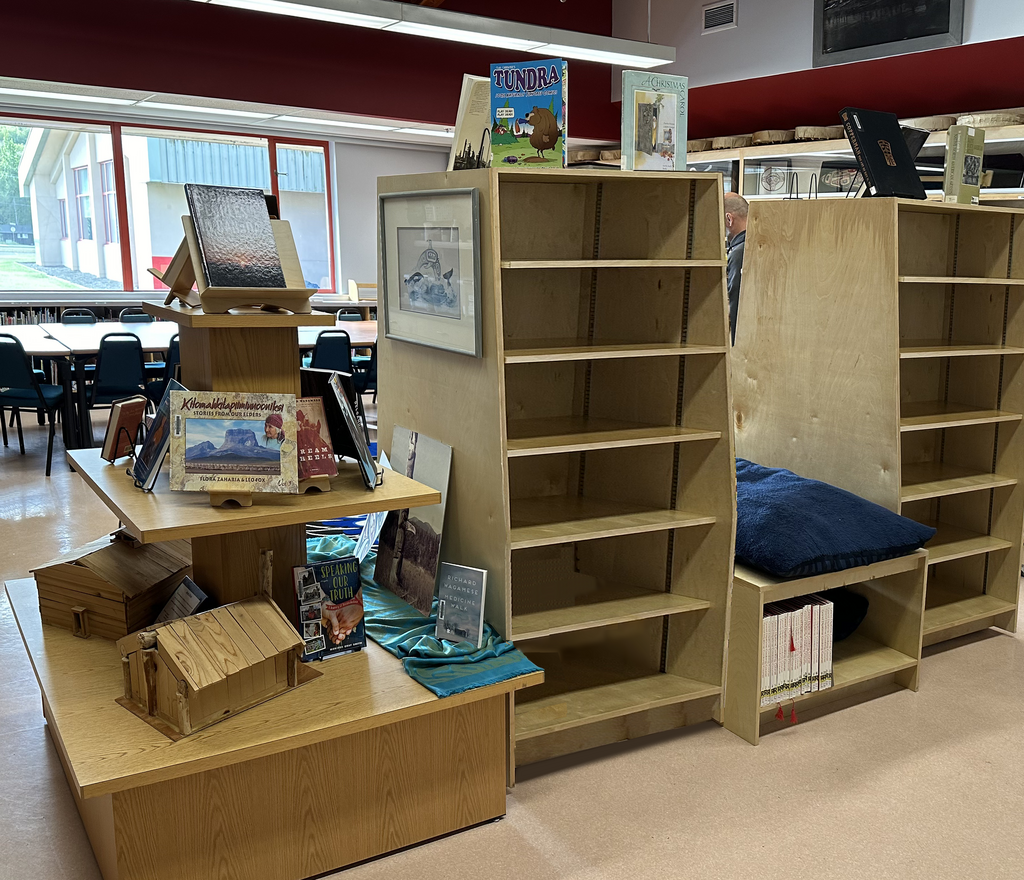
    Near the village of Hazelton, Write to Read BC volunteers recently delivered custom shelving required for the community’s school library. The shelves will also display important cultural objects, in both enclosed and open displays.

    New shelving and open displays of culturally important objects.
    New shelving, to be filled with books by the library response team. On the left is an open display case that shows framed historical photos and wooden models of traditional Indigenous housing.

    The school’s plan is nearing completion. The shelves were built for the library by Nanaimo Correctional Centre.

    This is the 23rd library the Write to Read BC project will install in isolated communities across BC, in partnership with the community.

  • Preparing to install Daylu Dena library

    Write to Read BC’s co-leads met to plan the installation of books and equipment in the Daylu Dena civic building by the end of the year.

    The building was completed a year ago, and the community and Write to Read BC are both eager to see the library installed.

    Since the library was built as part of a larger contract, it came fully finished with shelving and furniture. Write to Read library response team only needed to provide the books and computers, including a monitor. This reduced the need for financial input from Write to Read BC.

    Foyer and offices upstairs in Dalyu Dena's cultural and adminsitration building.
    The library is on the upper level, with a glass wall to admit plenty of light.
  • Visit to Daylu Dena’s civic-building site


    This month, Write to Read BC’s design response team visited Daylu Dena, just south of Watson Lake, BC. Visitors included lead architect Scott Kemp and Ryan Arsenault.

    Daylu Dena civic building: a construction site in winter.
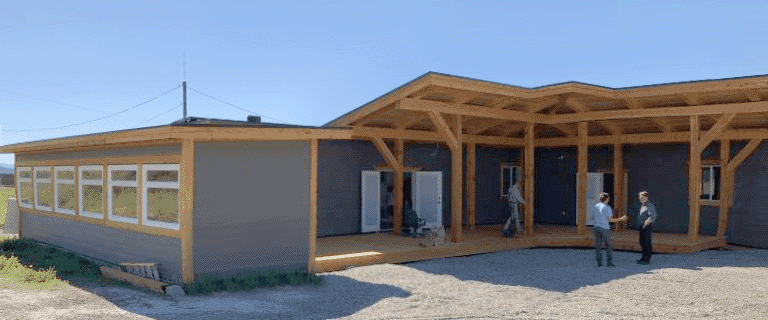
    For our visit in late 2023, the Daylu Dena civic building was a winter construction site.

    The community is constructing a cultural and administrative building that will be completed in 2024. The building will have:

    • a Service BC office for driver’s licensing and other government business.
    • administration offices and a council chamber for Daylu Dene community business.
    • an adjoining room for the judge’s chamber, so the council chamber can be used as a court room.
    • a large gym.
    • a commercial kitchen and a coffee shop.
    • a recording studio, and language room.

    An Indigenous library

    Of course, the Daylu Dena civic building will also have a Write to Read BC library, the first to be stocked only with Indigenous books.

    A site visit to the cultural and administration building as construction approaches completion.
    Write to Read BC volunteers inside the construction site, looking up at the future location of the library.

    The library is planned for the top floor, overlooking the foyer. Its glass wall will admit lots of light.

    There team will return in 2024 to help plan the library with the community.

  • COVID-19 slows Write to Read BC projects

    During the COVID-19 pandemic, widely recognised in 2020, several public health measures were adopted. This included lockdowns and limitations on travel and of access to public spaces, such as libraries and community hubs.

    As reported in 2020 and 2021, Indigenous communities used wholistic knowledge of health and previous pandemics to quickly protect vulnerable community members and reduce the spread of the virus. Nonetheless, health researchers reported in 2023 that the impact of COVID-19 was disproportionately higher among some—but not all—Indigenous communities.

    Understandably, many Write to Read BC’s partners in isolated BC communities continue to take a cautious approach to visitors. This affects Write to Read BC projects. Before the pandemic, previous consultation and collaboration happened face to face. In time, when the partnering communities are ready, this work can continue. When invited, Write to Read BC volunteers will be ready to actively continue our partnerships across BC.

  • Capilano Little Ones gets library

    One of Squamish Nation’s urban schools, Capilano Littlest Ones Xwemelch’stn School, celebrated its new library in November 2022. The school is on Squamish land in Greater Vancouver.

    The school brings together 130 Indigenous and non-Indigenous students in the Norgate area of urban North Vancouver. The school and its library help break down social barriers, build bridges across cultures, and re-establish positive relationships. Capilano Littlest Ones is a community school under the auspices of North Vancouver School District.

  • 14 palettes of books to Lax Kw’alaams

    The Lax Kw’alaams library, part of the Write to Read BC project, was featured in a Vancouver Sun article. It describes community reactions to the arrival of new library books.

    Excerpt from Vancouver Sun, March 20, 2021.

    By Douglas Todd

    “Please bring us more books” First Nation librarians ask.

    Naomi White still remembers her delight when she saw a barge full of books moving across the inlet to her village of Lax Kw’alaams, north of Prince Rupert.

    “It was amazing,” the First Nation librarian said.

    Six volunteers from Metro Vancouver helped haul in 14 pallets of books and library furniture so that about 150 school-age children in the small village, 1,000 kilometres north of Vancouver, would get the chance to enhance their literacy.

    “If you don’t know how to read, you don’t know how to do anything,” White said, explaining how literacy is the key to more First Nation people advancing into higher education and holding down jobs in the trades, businesses and professions.

    “We’re just so isolated here, especially during COVID. Now we’re better able to foster the love of learning. And to pass on that reading is power. The more you know the better off you are,” said White, describing how many young people in the village are keen to learn about the larger world through the library.

    For the full article, use this link to the Vancouver Sun, or open this PDF version stored on our website.