Tag: Write to Read BC

  • SFU CERi publishes report on Write to Read BC success

    Write to Read BC welcomes the formal publication of a study it co-sponsored with CERi at Simon Fraser University. CERi, or Community Engaged Research initiative, funded an assessment of 15 years of Write to Read BC’s collaborative library projects.

    The qualitative study collected data from 19 Indigenous BC communities about their Write to Read BC libraries model. The study’s authors, Jody Bauche and Tara Mahoney, report that these projects evolved far beyond designing and placing Indigenous-led libraries.

    Communities value the flexibility of the Write to Read BC model, which allowed them to design their own public space. As a result, these libraries can now offer an astonishing range of services beyond reading and education. These libraries are multi-purpose community hubs. They support cultural programming, early years education, food distribution, meetings, and social connection in isolated Indigenous communities across BC.

    The findings in this report highlight several key areas of impact:

    • Strengthening community connection and belonging.
    • Providing trusted spaces where people gather across generations.
    • Supporting literacy and lifelong learning, including early literacy development.
    • Inspiring the emergence of new programs.

    About the report

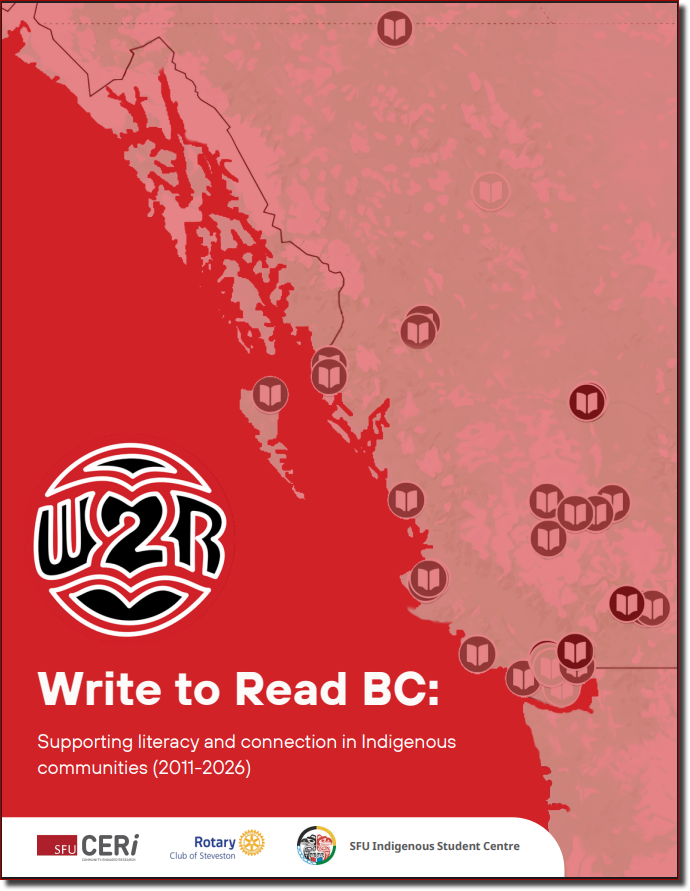
    Cover of 2026 report of the impacts of Write to Read BC's collaborative library model.
    Retrospective: The impact of collaborative libraries.
  • Human Rights book club inspires list of favourites

    The BC Human Rights Commissioner started a book club focused on human rights, and asked us to share this with our network.

    This inspired Write to Read BC volunteer Gordon Yusko to ask Indigenous publishers for their favourite books about human rights. Alison at GoodMinds.com—a Write to Read BC sponsor—suggested the following, for different types of readers.

    We’re passing along this list of favourites to all BC libraries.

    Goodminds.com is a book supplier with a passion for First Nations, Metis, and Inuit authorship and education. Through its SILT Foundation, it also funds and supplies books to libraries.

  • Four library projects for 2026-2027

    Write to Read BC volunteers are currently collaborating with four Indigenous organisations or nations:

    • Daylu Dena in northern BC.
    • Aboriginal Housing Society in Prince George.
    • Tl’esqox (Toosey) library in Caribou-Chilcotin.
    • Nzen’man’ (Zenmin) Centre in Lytton.

    Together with community members, a variety of Write to Read BC volunteers will:

    • specify what library shelving to build for upcoming library projects.
    • coordinate book donations with supplier GoodMinds.com.
    • ship books to a volunteer in Whitehorse, relatively close to Daylu Dena library in northern BC.
    • complete the Daylu Dena library installation.
    • meet with Aboriginal Housing Society in Prince George to determine the library needs of multiple generations.
    • assess the available space and work on a design with Aboriginal Housing Society and stakeholders.
    • assess the space and shelves in the Tl’esqox library.
    • edit the Tl’esqox collection: cull books and develop a replacement book list.
    • firm up the 2027 Nzen’man’ project in Lytton.
    • check the type of fire-suppression—either water or foam—in the Nzen’man’ Centre, to frame the project scope.
  • Conference attendees respond to Write to Read BC projects

    During a presentation about Indigenous BC libraries, attendees at 2026 BC Library Conference expressed interest and engaged with the panel of presenters. The conference is an annual event sponsored by BC Library Association.

    Panel shared a recently completed impact study of Write to Read BC’s collaborative projects with isolated Indigenous communities. After the presentation, the audience shared their own experiences as librarians. They also asked questions about process, to learn how to better serve indigenous readers in public libraries.

    Indigenous groups in public libraries

    One librarian noted that, in the past decade, public libraries in Canada have taken “hugely positive steps” by adding Indigenous books and content to their collections. The librarian said, “There’s a lot more programming focused on Indigenous history in Canada, including the horrible impact of Indian Residential Schools.”

    Others noted public libraries have actively recruited local Indigenous residents to be on their library boards.

    Another librarian said: “In our library we reach out to two local First Nation communities,” but added that this work has no government funding. “The province doesn’t really provide enough funding to cover the costs,” said the librarian.

    Members of the audience were not asked to identify themselves, so their comments aren’t attributed.

    Processing books

    One librarian asked about how Write to Read BC’s volunteers process books for Indigenous libraries.

    Indigenous libraries installed with Write to Read BC have new books from Indigenous publishing houses in their collection. They may also have a selection of other books. The Write To Read volunteers classify all these books using the Dewey Decimal system.

    A panel presenter noted that Indigenous youth in particular want to learn it. Knowing Dewey Decimal allows them to go into a public library knowing where to find the books they’re interested in.

    After the conference presentation, several librarians asked about volunteering with Write to Read BC to process books.

    Self-directed, Indigenous-led libraries

    Rather than support public libraries in making space for Indigenous readers, Write to Read BC takes a different approach. Its volunteers partner with isolated Indigenous communities to design and and install the library they themselves want.

    The focus has been on isolated communities that have no other library nearby. However, Write to Read BC has also partnered with Indigenous-led organizations and schools that want a library.

  • Impact presentation at 2026 BC Library Conference

    2026 BC Library Convention attendees will hear an evaluation of the Indigenous-led libraries installed in partnership with Write to Read BC. Speakers will present the findings of a recent impact study of 15 years of Write to Read BC projects. In their April 23 conference presentation. Speakers will also discuss at future directions, and relationships with the larger library community in the province of BC.

    About the three speakers

    One speaker is the academic who led the impact assessment. The others are Write to Read BC members.

    • Jody Bauche is associate professor at Royal Roads University, and a citizen of the Metis Nation of BC. She led the research for the impact study in this presentation.
    • Dr Shirley-Pat Gale, Nih tse digh—Tl’esqox na whelh deni heelen (adoptee of Tl’esqox)—is a passionate literacy advocate and lead of Write to Read BC.
    • Gordon Yusko is a Write to Read BC advisor and facilitator, and master of library studies and information science, who has worked in public and academic libraries, in leadership roles.
  • Indigenous libraries: impact on confidence, wellness, digital equity

    A Simon Fraser University researcher says Indigenous-led libraries, combined with community schools, have benefits beyond learning and literacy. A recent study of 20 Indigenous-led BC libraries listed many more benefits. These include social confidence, community inclusion, wholistic literacy, emotional wellness, digital equity, as well as generative learning. Let’s examine these findings more closely.

    The findings are part of a study of Write to Read BC’s library-building partnerships with isolated communities. The study results are scheduled to be published in the spring of 2026. Simon Fraser University’s Community-Engaged Research initiative (CERi) arranged the study to evaluate Write to Read BC’s ongoing libraries project.

    Context: Indigenous education in BC

    By embedding Indigenous culture in what teachers teach, schools in First Nations communities improve accomplishment and fulfilment for their elementary students. M.A. Burgess reported this in a University of Northern BC doctoral dissertation in 2017. Burgess further reported that community engagement and collaborative decision-making is key to grounding the school experience in the local culture.

    Libraries have similar benefits for the community, not just for school-age children. When Indigenous communities co-create and co-deliver school programs, students experience high levels of community support and participation. Interestingly, this applies both to schoolchildren and family members. Indigenous-led community libraries play a part in this. Tasha Riley and 3 others reported this in their 2025 work on digital literacy in remote Indigenous community.

    Benefits: Indigenous community libraries in BC

    Indigenous community libraries often work alongside community schools and literacy programs in isolated communities. In BC, First Nations schools are funded through Indigenous Services Canada, and are often run independently from the provincial government. Libraries are funded with the support of non-profit organisations and projects such as Write to Read BC.

    The benefits of Indigenous-led libraries for education include:

    • Social confidence and community inclusion. Community libraries can improve literacy as well as the confidence of individuals and social groups. Ongoing, positive community inclusion and active participation is key.
    • Wholistic literacy and emotional wellness. Libraries in isolated communities help people connect reading and writing skills with meaning and purpose. This experience can be intellectual, emotional, social, and cultural. People can also experience this through an online computer, using a library’s online learning centre. Rob McMahon and others reported this in Codesigning community networking, in 2024. They found that being connected to others enhances social and emotional well-being.
    • Digital equity. Libraries that have an online learning centre rebalance the “digital divide” isolated Indigenous communities experienced historically. Given the global scale and adoption of digital technologies, online learning is crucial for all students. With it, they can develop their capacity for critical engagement rather than passive consumption of content. Critical digital literacy lets community members use global learning platforms, knowledge networks, and economic forums. Clearly, this can then inform Indigenous self-government.
    • Generative learning. Education delivered in the community that involves other community members will maintain and strengthen the community. This occurs by integrating new ideas and information with existing knowledge. Jessica Ball reported this in American Indian Quarterly in 2004. She reported that the benefits of library use and learning extend beyond the students themselves. This is often in ways that cannot be predicted or measured. Ball wrote that the spontaneous generation of new knowledge and new behaviour is essential to keep living communities alive.

    The research for this report was conducted in 2025. The report, in its final form, will be published in the spring 2026.

    Research on the impact of Indigenous-led libraries installed together with Write to Read BC in isolated BC communities.
  • Study: Libraries serve Indigenous children and adults alike

    The preview of an upcoming study reports adults in isolated, Indigenous communities use libraries as much or more than children. The study is assessing at the long-term impact of Indigenous-led libraries installed in partnership with Write to Read BC.

    This research was made possible with Simon Fraser University’s CERi funding. The study’s Indigenous researcher gathered data from isolated communities that installed an indigenous-led library with us. The research was conducted in 2025, and the report will be published in spring 2026.

    School libraries

    Many communities installed a library connected to their local school. Obviously, these spaces get significant use by children.

    However, adults also want to use reading materials and programs about culture and language. That’s why some schools welcome adults, too. For example, Nisaika Kumtuks school in Nanaimo set specific hours for family members to use material in its library.

    Rather than in a school, many communities installed books and computers a separate community facility. Both children and adults can use these, but they are harder to fund, according to some study participants. “There is funding for libraries attached to schools, but not necessarily for community-specific libraries,” the study’s author reports.

    Nevertheless, over the past 15 years most libraries installed with Write to Read BC are community libraries.

    Community libraries

    In addition to support for reading—including reading about Indigenous cultures and languages—these spaces are also community-building hubs. This is one of the benefits that attracts community members. Often, libraries are a showcase of local culture and history. One participant mentioned plans to create a museum alongside the library.

    In addition to these adult-oriented activities, community libraries also help educate children. Since 20% of the youth living on reserves attend school online, community libraries often have a role in childhood education.

    Unfortunately, older libraries in the Write to Read BC program did not all include computers and high-speed Internet. Some participants told the researcher that “a designated space” for online learners would be “a helpful addition to their community.” This would benefit adults and children alike.

    Findings from the CERi study were first presented in October, 2025.

    Research on the impact of Indigenous-led libraries installed together with Write to Read BC in isolated BC communities.
  • Value in isolated libraries: SFU study

    An Indigenous-led study at Simon Fraser University will sum up 15 years of Write to Read BC library projects. The study assessed 15 years of completed projects. These projects are partnerships with Indigenous communities to design and install the library they want. In a preview of the findings, the study found that project partners—isolated indigenous communities across BC—gained substantially. The gains show up in several ways.

    Firstly, at a community-wide level libraries are places where people connect, the study found. It reports that Write to Read BC libraries foster resiliency and increase active community participation. That’s in part because the libraries also become community hubs.

    Secondly, individual or “autonomous” library use is also connected to increased productivity within communities.

    Thirdly, the effect on literacy is positive. The study found an increased interest in literacy related to community libraries installed by Write to Read BC.

    Lastly, the Indigenous-led study noted several community challenges indirectly related to libraries. For example, due to shifts in literacy funding, schools have been absorbing community-based programs. Also, expanding those community programs increases the demand for meeting space. A community library can ease the demands on schools and provide another place to host programs.

    Full details of the findings will be available when the research report is published in the spring of 2026. The study, which Write to Read BC requested, received funding from SFU Community-Engaged Research Initiative, or SFU CERi. This program helps community organisations understand the effectiveness of their efforts. The research applied Indigenous cultural insight of a Simon Fraser University (SFU) graduate student.

    Write to Read BC leaders and the Rotary Club of Steveston-Richmond recently got a preview of the study. That’s because the Rotary Club is a significant funder of the Indigenous-led libraries that Write to Read BC volunteers install. Over the past 15 years, these partnerships have resulted in about two dozen libraries in isolated communities across BC.

    Research on the impact of Indigenous-led libraries installed together with Write to Read BC in isolated BC communities.
  • Promoting Write to Read BC with BCLA librarians

    Today, Write to Read BC announced the launch of this updated website to members of BC Library Association, or BCLA. That’s because BCLA members are well placed to promote the Write to Read BC project. The announcement also mentions an upcoming impact study about communities that have an indigenous-led library.

    BC Library Association logo.

    The role of librarians

    Librarians focus on advocacy, professional development, and support of intellectual freedom. BCLA members work to ensure everyone has equitable access to information, ideas, and works of the imagination. In contrast, Write to Read BC does the same by following the lead of First Nations communities.

    The announcement to BCLA

    This is what today’s announcement covered:

    On this National Day for Truth and Reconciliation it’s fitting to announce two things about the long-lasting Write to Read BC project.

    1. There is a new website, writetoreadbc.org.
    2. An impact study is in its final stages, with a report scheduled to be released in November.

    As many of you know, former lieutenant-governor of BC Steven Point envisioned and initiated this project during his time in that role between 2007 and 2012. A key partner in making the project a reality was his aide-de-camp at the time, Bob Blacker, an active member of a Rotary Club. CBC carried a story about this joint effort in May of 2014, as did various newspapers.

    Fast forward and along the way to 2025, Write to Read BC has collaborated with numerous Indigenous communities, under their leadership, to plan and install highly local libraries and learning centres. The new website documents these multiple efforts going back to 2011.

    Funding and support for the new website and the impact report was generously provided by SFU’s Main Street Research Shop. It collaborates with community partners, students, and faculty members to address community questions and concerns through research. The SFU Indigenous Student Centre has been equally generous in contributing in-kind support for a portion of the work schedule to co-supervise both the research and the web development.

  • Daylu Dena library books coming soon

    The co-leads of Write to Read BC plan to travel to Daylu Dena’s new library in early November 2025. They will deliver books and computers.

    The books will provide the indigenous focus that the community envisioned for its library.

    The computers and high-speed Internet connection will allow the library to offer remote access to online courses and conferences. Librarians typically refer to this as a learning centre.