The Tsilhqot’in National Government represents Tl’etinqox (Anaham), Tsi Deldel (Redstone), Yunesit’in Government (Stone), Xeni Gwet’in First Nation Government (Nemiah), Esdilagh (Alexandria), and Tl’esqox (Toosey).
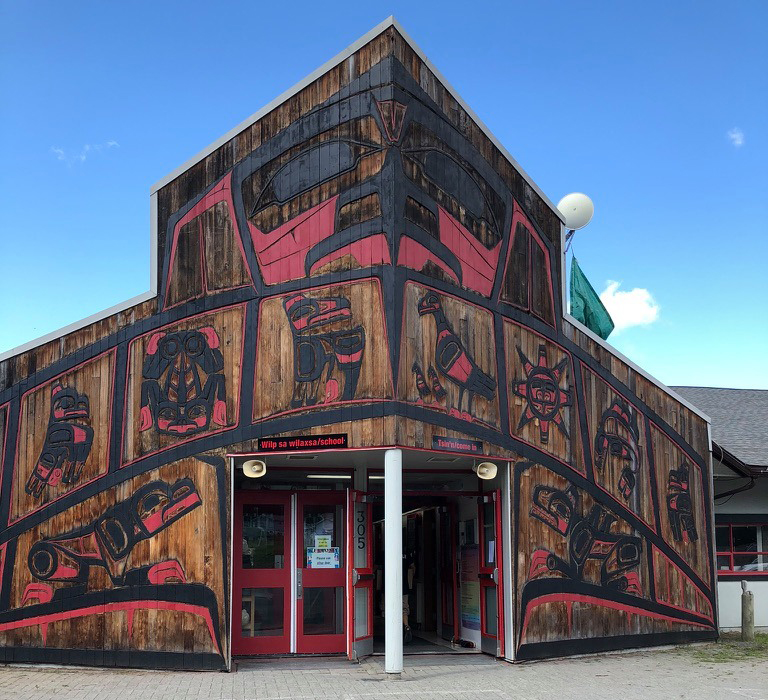
The Toosey First Nation (or Tl’esqox First Nation) is a Tsilhqot’in First Nation in the Fraser Canyon region of BC. It is 50 km west of Williams Lake. Its Indian Reserves include:
Baptiste Meadow Indian Reserve No 2, on Riske Creek, 5 km northwest of the Riske Creek post office, 2.6 km².
Toosey Indian Reserve No. 1, on Riske Creek, 6 km west of its mouth on the Fraser River. 23.4 km².
Toosey Indian Reserve No. 1A, west of Indian Reserve No. 1, about 0.1 km².
Toosey Indian Reserve No. 3, 5 km east of the mouth of Riske Creek, 0.5 km².
Toosey Chief Frances Laceese in 2014
The reserves are about 40 km south of Williams Lake. Many run and work on farms and cattle ranches, or work in trapping or logging. The band has a woodlot license.
Elders provided information about Tŝilhqot’in land use, language, history, traditions, and laws, which played and will play an important role in legal decisions about Title for the Tŝilhqot’in Nation. This information helps protect important sites from logging and mining operations. It also has a purpose in education about Tŝilhqot’in culture, history, laws, and language.
About the library
This was the first library that Write to Read BC installed. Sponsors included Rotary Club of Williams Lake Daybreak, Rotary Club of Langley Central, and Britco Structures (now Boxx Modular).
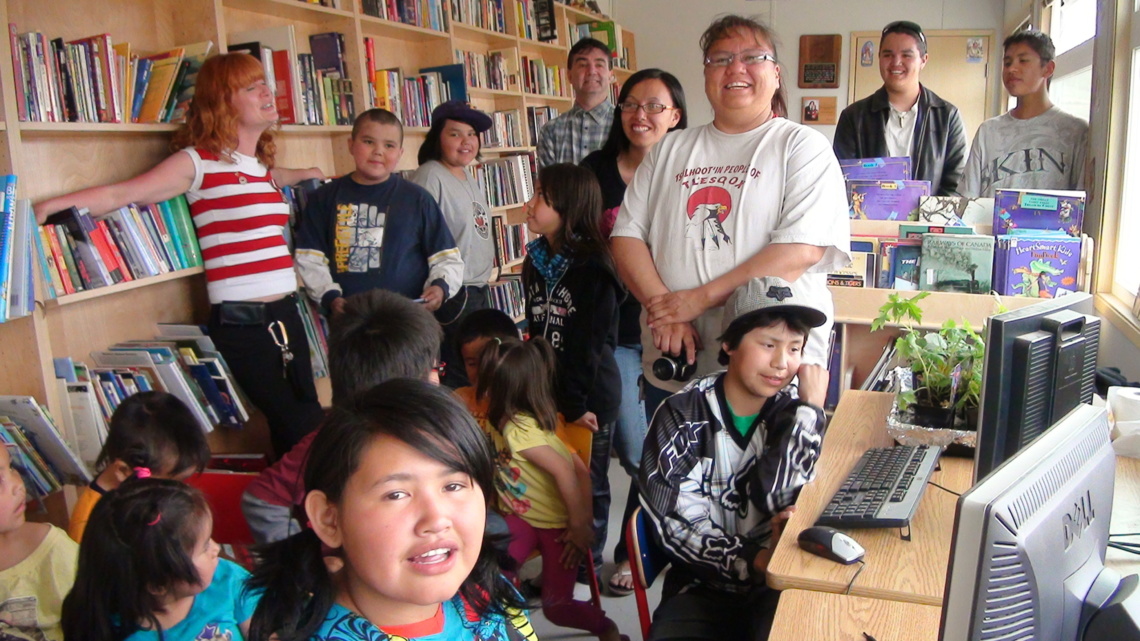
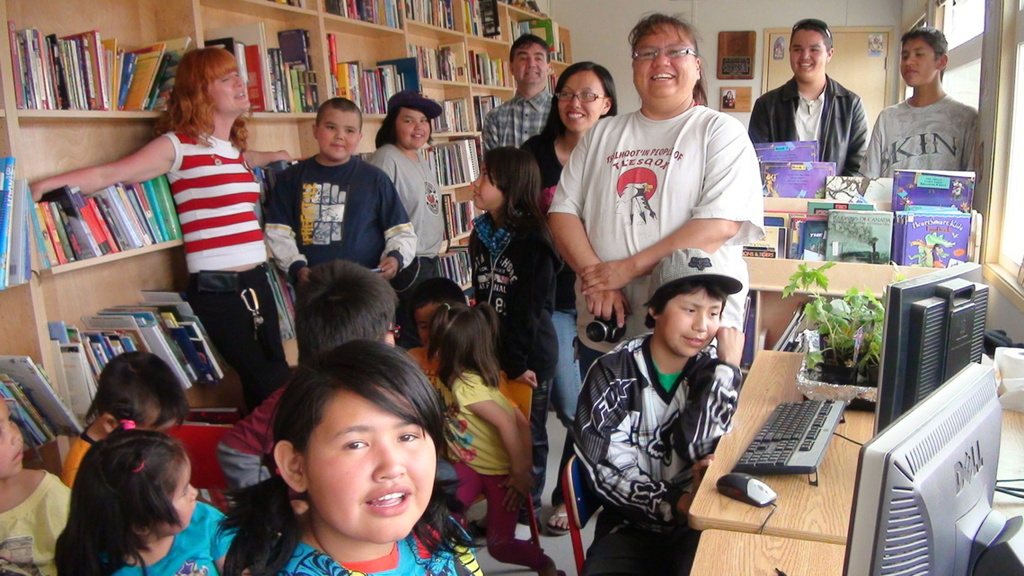
Community members in the library’s learning centre at the Tl’esqox library.
When Gitsegukla elementary school principal Louise Ormerod talks about her school’s journey from failure to success—not just for the Kindergarten to Grade 7 students, but also for adult learners in the community—Write to Read BC gets part of the credit.
School risked getting shut down
In 2018 the BC Ministry of Education assessed the school. It failed. The ministry said the school would be closed if it didn’t resolve the 21 violations ministry auditors found. The community also knew the school was poor. Some families left the community so their children could get an education. New teachers quickly left.
But two years later, when auditors returned, they found a vast improvement. The school was “teaching to the curriculum” and meeting BC Ministry of Education standards. Auditors observed the school had found the resources every elementary school needs. Literacy rates increased 400%. Teachers stayed.
Ministry auditors told Ormerod that hers was the only audited school that did not have a single violation that year. Ormerod credits her staff and the community’s commitment to saving education in their community. She says Write to Read BC not only played a role, but made it easy, by being prpared and by knowing who to call to solve various problems. As for the library Write to Read BC installed, Ormerod says, “we had the best library and learning centre we could have ever asked for to support that learning.”
The story on video
In this 9½-minute video of an online talk, Ormerod tells the story of her school’s journey.
School principal Louise Ormerod talks about improving literacy and numeracy at her school.
Ormerod also gives advice to other schools who want to develop a library of their own:
Give the library a formal opening, with all the fanfare it deserves, to acknowledge the accomplishment. Gitsegukla school missed theirs because of Covid-19 restrictions.
Identify a champion who’s passionate about maintaining the facility once it’s launched.
Open the library after hours, so adult community members can use the library, and can attend online courses by using the library’s learning centre.
Get trained to manage a digital lending system.
Ormerod credits the expertise and connections of Write to Read BC’s volunteers, and the fundraising efforts of the Rotary Club for helping to make success possible for Gitsegukla Elementary and the whole community.
Success despite COVID-19
The community, the school, and Write to Read BC installed a library while complying with COVID-19 restrictions. The shelving, furniture, books, and computer equipment were installed during a school holiday, because students were offsite then. Obviously, the out-of-town volunteers could not socialise or stay with community members.
The Nlaka’pamux Nation has many bands, whose traditional territory includes parts of the Thomson River, Fraser Canyon in BC and south into the North Cascades region of the USA. The Nation is constructing a multipurpose community centre in Kumsheen, or Lytton.
The centre will include spaces for childcare, youth programming, cultural gatherings and celebrations, and for knowledge exchange and language revitalization. This project will also include a commercial teaching kitchen, a community café, and an Elders lounge. The building is designed with a strong focus on sustainability, cultural preservation, and climate resilience.
About the library
In 2027, Write to Read BC plans to install a reading room in partnership with the Nlaka’pamux Nation.
One of Squamish Nation’s urban schools, Capilano Littlest Ones Xwemelch’stn School, celebrated its new library in November 2022. The school is on Squamish land in Greater Vancouver.
The school brings together 130 Indigenous and non-Indigenous students in the Norgate area of urban North Vancouver. The school and its library help break down social barriers, build bridges across cultures, and re-establish positive relationships. Capilano Littlest Ones is a community school under the auspices of North Vancouver School District.
Write to Read BC volunteer Margaret Fletcher will speak to the Community-Led interest group of BC Library Association, or BCLA. Fletcher will discuss how Write to Read BC partners on projects in isolated communities across BC. She’ll also talk about the impact these projects have on social barriers and reinforcing community culture. This includes the installation of Internet-connected computers that provide remote access to courses and conferences through these learning centres.
The association’s interest group meets quarterly, with its next meeting in December.
The BCLA Community-Led interest group is about a community-led service approach, which consists of community consultation, needs assessments, metrics, and ongoing monitoring of services and programs. The interest group’s members want to connect and collaborate with community members to better support their needs.
At its core, the community-led model is about reducing or eliminating barriers to library services and programs. Another key factor to the community-led approach is staff training and development within the communities.
In April, Write to Read BC members identified 10 libraries eligible for funding from the Supporting Indigenous Libraries Today foundation, or SILT. Its goal is to support Indigenous communities that do not currently have a public library, and to help existing First Nations public libraries to expand.
SILT foundation is set up by Goodminds.com, which donates 5% of sales to the foundation.
SILT supports Write to Read BC with generous funding. In Bella Bella, a Write to Read BC library received books worth $10,000 this summer. SILT also donated over $8,000 to support the Gitsegukla community library in BC with a donation of new books.
Write to Read BC co-lead, Bob Blacker, said: “The response to these books from our communities has been amazing. For the kids, it is the best part of the library. SILT is a true platinum sponsor of our project.” Blacker gives his heartfelt gratitude to Goodminds.com owner Achilles Gentle, and former owner Jeff Burnham.
Burnham is a member of the Write to read BC team of volunteers.
Blacker invites indigenous-led libraries in BC to contact Write to Read BC for information on how to access and use SILT funds for books.
The Lax Kw’alaams library, part of the Write to Read BC project, was featured in a Vancouver Sun article. It describes community reactions to the arrival of new library books.
Excerpt from Vancouver Sun, March 20, 2021.
By Douglas Todd
“Please bring us more books” First Nation librarians ask.
Naomi White still remembers her delight when she saw a barge full of books moving across the inlet to her village of Lax Kw’alaams, north of Prince Rupert.
“It was amazing,” the First Nation librarian said.
Six volunteers from Metro Vancouver helped haul in 14 pallets of books and library furniture so that about 150 school-age children in the small village, 1,000 kilometres north of Vancouver, would get the chance to enhance their literacy.
“If you don’t know how to read, you don’t know how to do anything,” White said, explaining how literacy is the key to more First Nation people advancing into higher education and holding down jobs in the trades, businesses and professions.
“We’re just so isolated here, especially during COVID. Now we’re better able to foster the love of learning. And to pass on that reading is power. The more you know the better off you are,” said White, describing how many young people in the village are keen to learn about the larger world through the library.
After a long drive from Prince George, the installation team arrived in Gitsegukla at 2:45pm on a Tuesday, ready to install a library for the school and community.
The installation took 3 days, while the school was closed for holidays. To comply with COVID-19 restrictions, the out-of-town volunteers obviously could not socialise or stay with community members. The efforts of the volunteers, including members of Write to Read BC’s library response team, were planned from start to finish.
A literacy-focused addition to the community.
On arrival, the library response team swung into action, with the school staff and principal Louise Ormerod. Once the furniture was unloaded, the library response team started organizing the layout of the learning centre, with its internet connection that allows remote attendance at courses and conferences..
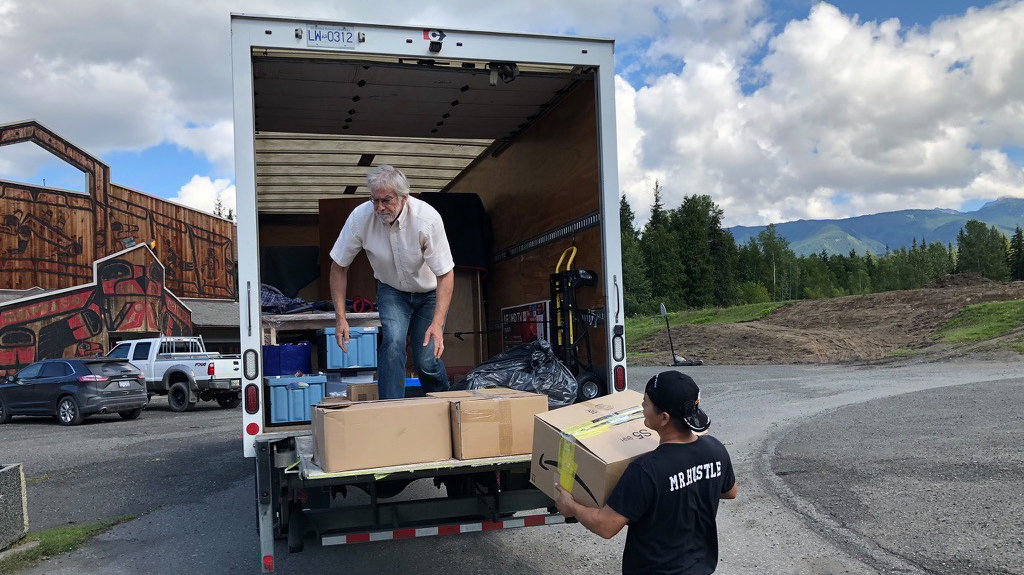
Volunteers unloading a delivery of library books.
Fetching sponsors
On Day 1, the team started early and progressed well. Total Support Services Chief executive officer Chris Gillen made a “quick” 3-hour return trip to Terrace to fetch more shelving tabs and an HDMI cable for the TV.
Chris Gillen of Total Support helps troubleshoot the learning centre’s computers at no cost.
How Total Support Services joined Write to Read BC
For a Victoria-Harbourside Rotary Club meeting a few weeks before the Gitsegukla library were installed, Write to Read BC co-lead Bob Blacker gave a presentation about the program, by video call. One of the audience members mentioned that her son-in-law was working with First Nations to provide computers, IT solutions, and training. A few days later Bob received a call from Chris at Total Support, expressing interest. As a result of this connection, Write to Read BC now has a supplier of computers and related hardware needed for learning centres. In addition, Total Support will, at no cost to the libraries—provide online support for any computer problems that surface. This has been huge for Write to Read BC, as support for computers has always been a concern; now we do not have to worry about that.
After 3 days of hard work, the Write to Read BC team, along with principal Ormerod and her staff, completed Write to Read’s very first “version 3” learning centre.
We had some hiccups over the three days, which is to be expected, but we were able to prevail. The new library and resource centre looks great.
Masks off for the group photo: The satisfied team that installed the library and learning centre.
Preceded by planning and design
The team leads recalled the process that led to the installation of this library.
The Write to Read BC team met with Chief Willie and three council members, overlooking Princess Lake. This meeting allowed members of the team to chat with key members of the community. The evening ended with a handshake between Chief Willie and Write to Read BC team co-lead, Bob Blacker, cementing the agreement and the blossoming friendship and trust with Gitsegukla.
As one of the team members said: “This is what makes it all worth it.”
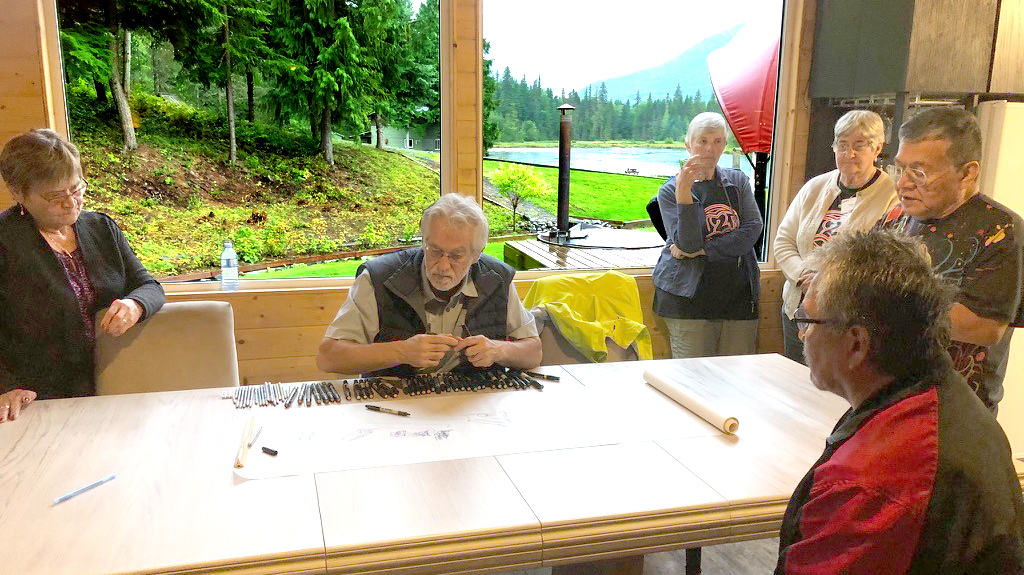
An earlier imagineering session: What does the community’ envision next?
The evening was topped off with an imagineering session, lead by design response team member, Scott Kemp. This was also a new experience for the Write to Read BC team.
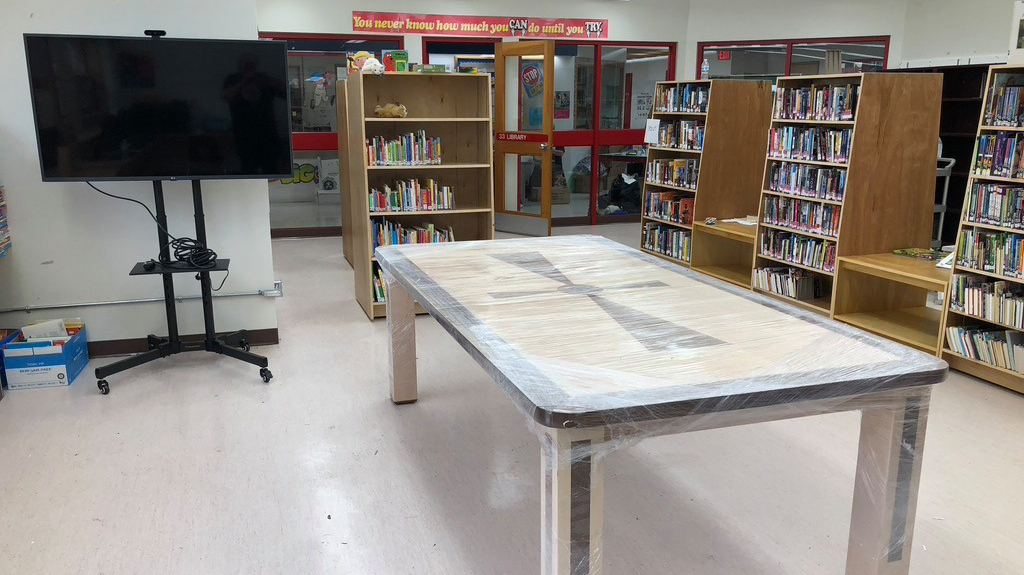
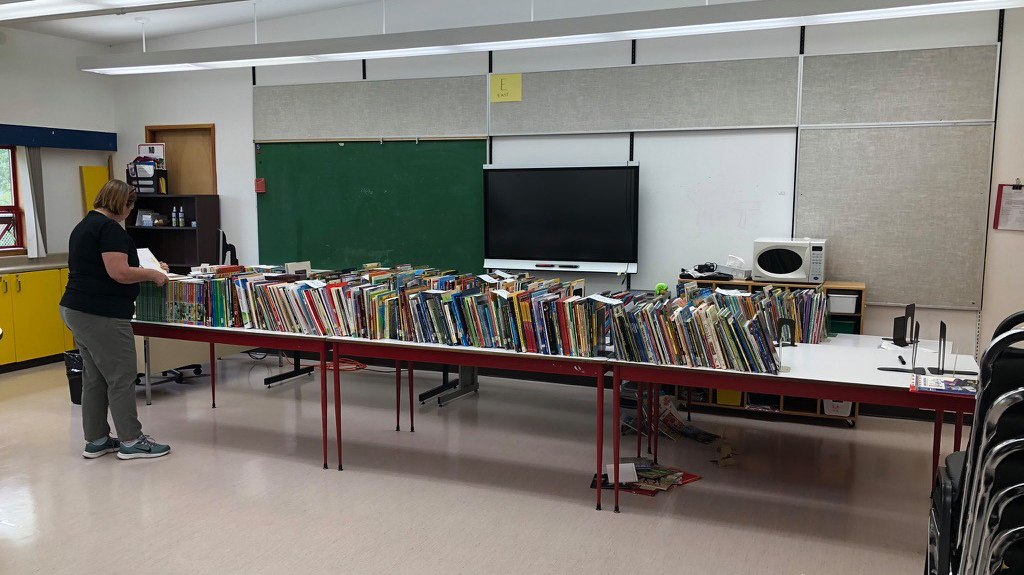
Key components of the learning centre: a large screen and a computer table.At this point still a warehouse of books, this room will soon be a classroom.
Xeni Gwet’in First Nations Government, part of the Tŝilhqot’in Nation, is about 200 km west of Williams Lake, BC. Tŝilhqot’in is often translated as People of the River, or People of the Blue Water.
About one third of the Xeni Gwet’in community’s 400 members lives on their traditional territory. The people in Xeni Gwet’in maintain their land and their system of governance, as they always have. The land is a unique ecosystem, mountainous, crossed by glacial waterways and covered in forest. The government works towards community self-governance, with an emphasis on unity, respect, trust, and pride in the Tsilhqot’in heritage, language, and culture. The goals of Xeni Gwet’in government are to conserve the natural resources of its territory, keep the ecosystem healthy, in an economically sustainable way.
The band runs the local roads yard as well as a gas-bar, and built a housing subdivision with its own electrical grid, since the community is not connected to the main BC Hydro grid. The band manages its health program, and the local school serves Kindergarten to Grade 8 in three classrooms. Its teachers are long-term residents.
About the library
In partnership with the community, Write to Read BC discussed the vision for a library, which was then designed and constructed.
Write to Read BC’s design response team visited the Sxoxomic Community School at Esk’etemc, and ended up designing a library with the kids. Although the students are not designers, they have clear ideas about how to lay out their library.
This beautiful new school did not yet have a library.
Our co-lead Dr Shirley-Pat Gale heard from new elementary school’s principal that the school does not yet have a library.
Gale, brought in Write to Read BC’s design response team, architect Scott Kemp, and co-lead Bob Blacker. The team mixed with grade 7 students, and magical things happened.
During an amazing lunch-and-design session with the kids, the team designed its layout, including where the new shelving would be placed. The shelves will be made by the Nanaimo Correctional Centre. All that remains is for library response team lead Margaret Fletcher to visit the school to review what books they’d like, and then the school can contact our Aboriginal book distributor GoodMinds.com and Jeff Burnham to purchase the aboriginal authored books that will make their library suit the community.
This was Write to Read BC’s first design session with students from an elementary school, and it was a success.