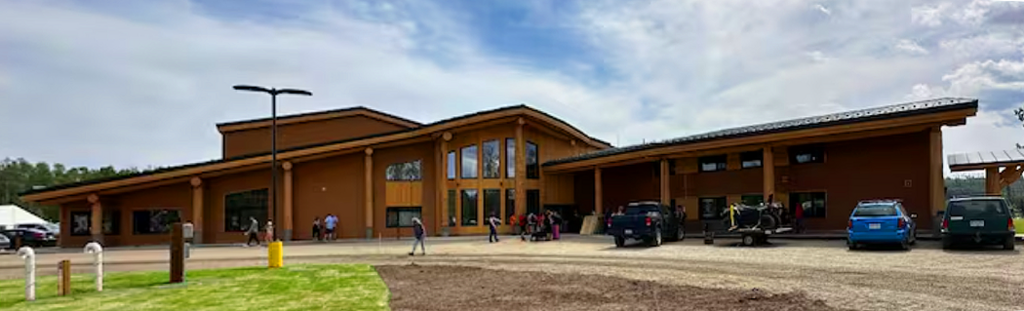
Write to Read BC’s co-leads met to plan the installation of books and equipment in the Daylu Dena civic building by the end of the year.
The building was completed a year ago, and the community and Write to Read BC are both eager to see the library installed.
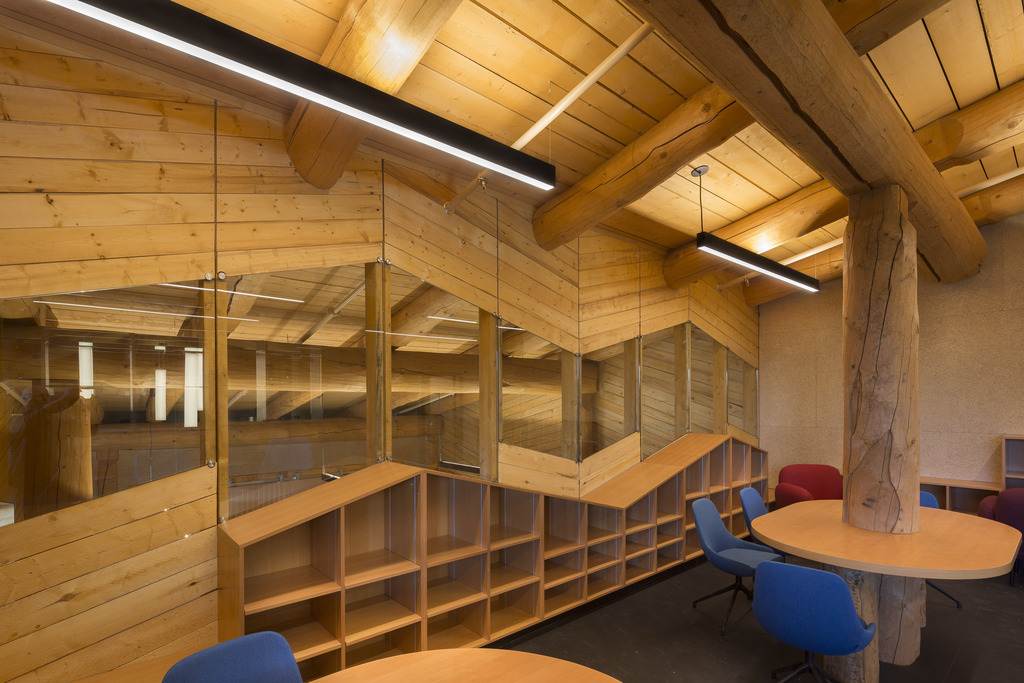
Since the library was built as part of a larger contract, it came fully finished with shelving and furniture. Write to Read library response team only needed to provide the books and computers, including a monitor. This reduced the need for financial input from Write to Read BC.
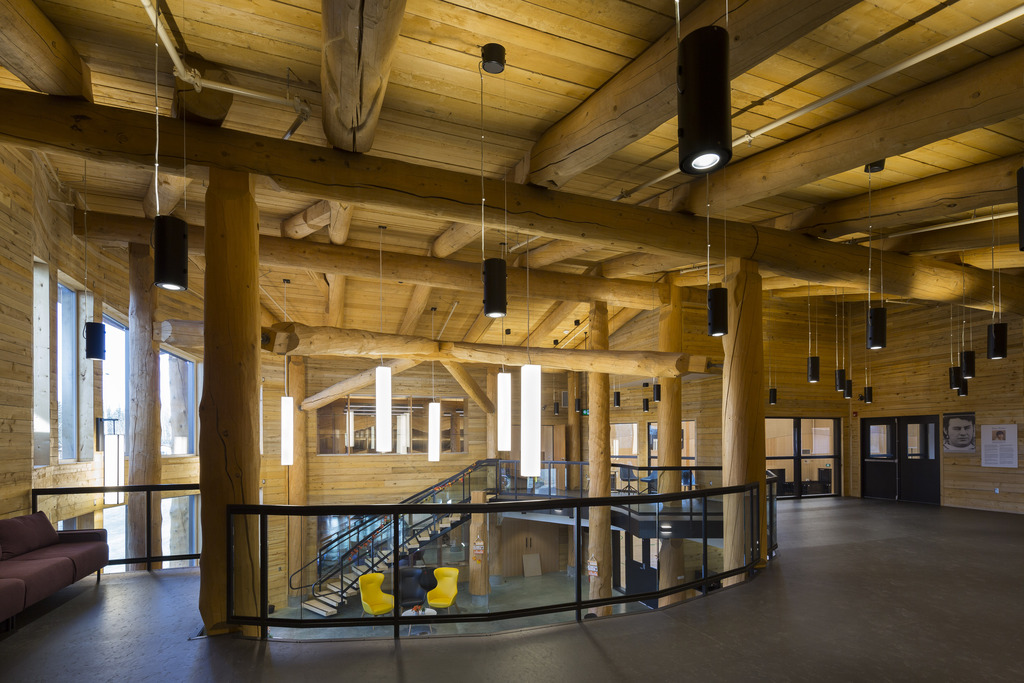
The library is on the upper level, with a glass wall to admit plenty of light.
This month, Write to Read BC’s design response team visited Daylu Dena, just south of Watson Lake, BC. Visitors included lead architect Scott Kemp and Ryan Arsenault.
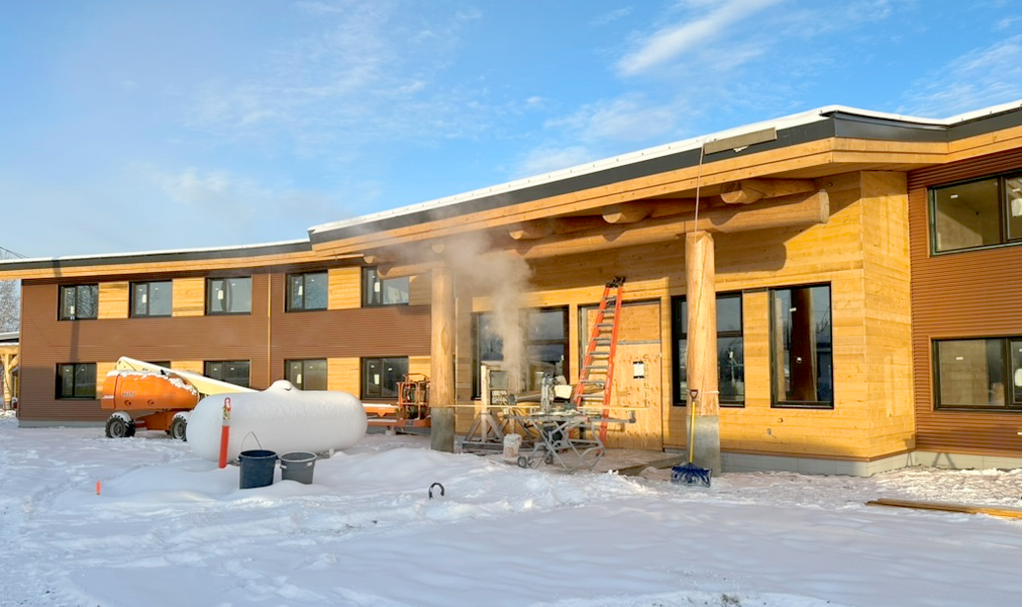
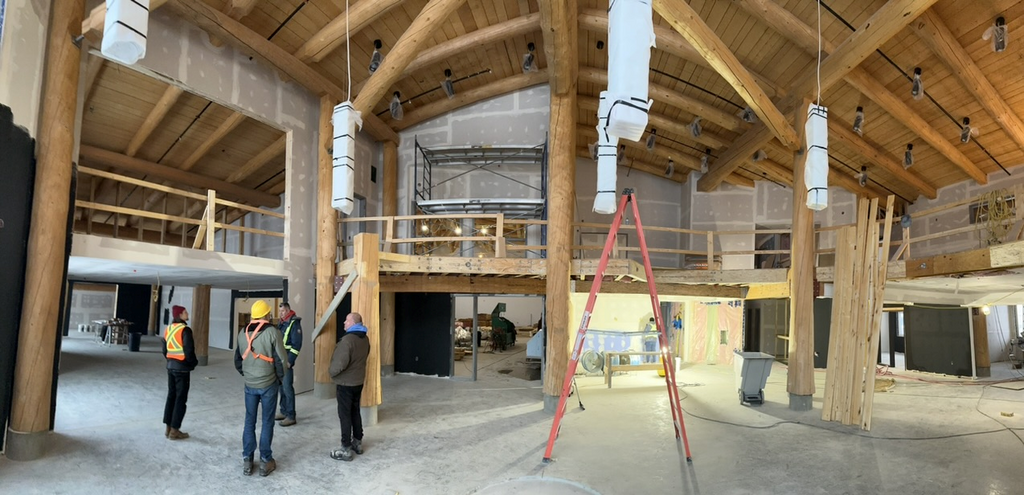
For our visit in late 2023, the Daylu Dena civic building was a winter construction site.
The community is constructing a cultural and administrative building that will be completed in 2024. The building will have:
a Service BC office for driver’s licensing and other government business.
administration offices and a council chamber for Daylu Dene community business.
an adjoining room for the judge’s chamber, so the council chamber can be used as a court room.
a large gym.
a commercial kitchen and a coffee shop.
a recording studio, and language room.
An Indigenous library
Of course, the Daylu Dena civic building will also have a Write to Read BC library, the first to be stocked only with Indigenous books.
Write to Read BC volunteers inside the construction site, looking up at the future location of the library.
The library is planned for the top floor, overlooking the foyer. Its glass wall will admit lots of light.
There team will return in 2024 to help plan the library with the community.
The Nlaka’pamux Nation has many bands, whose traditional territory includes parts of the Thomson River, Fraser Canyon in BC and south into the North Cascades region of the USA. The Nation is constructing a multipurpose community centre in Kumsheen, or Lytton.
The centre will include spaces for childcare, youth programming, cultural gatherings and celebrations, and for knowledge exchange and language revitalization. This project will also include a commercial teaching kitchen, a community café, and an Elders lounge. The building is designed with a strong focus on sustainability, cultural preservation, and climate resilience.
About the library
In 2027, Write to Read BC plans to install a reading room in partnership with the Nlaka’pamux Nation.
One of Squamish Nation’s urban schools, Capilano Littlest Ones Xwemelch’stn School, celebrated its new library in November 2022. The school is on Squamish land in Greater Vancouver.
The school brings together 130 Indigenous and non-Indigenous students in the Norgate area of urban North Vancouver. The school and its library help break down social barriers, build bridges across cultures, and re-establish positive relationships. Capilano Littlest Ones is a community school under the auspices of North Vancouver School District.
Write to Read BC volunteer Margaret Fletcher will speak to the Community-Led interest group of BC Library Association, or BCLA. Fletcher will discuss how Write to Read BC partners on projects in isolated communities across BC. She’ll also talk about the impact these projects have on social barriers and reinforcing community culture. This includes the installation of Internet-connected computers that provide remote access to courses and conferences through these learning centres.
The association’s interest group meets quarterly, with its next meeting in December.
The BCLA Community-Led interest group is about a community-led service approach, which consists of community consultation, needs assessments, metrics, and ongoing monitoring of services and programs. The interest group’s members want to connect and collaborate with community members to better support their needs.
At its core, the community-led model is about reducing or eliminating barriers to library services and programs. Another key factor to the community-led approach is staff training and development within the communities.
Write to Read BC has been selected to participate in a panel discussion at the conference for Libraries, Archives and Museums Nova Scotia (LAMNS). The panel will discuss its partnerships with isolated BC communities to install indigenous-led libraries.
The panel takes place on Friday, October 22, and includes our co-lead Bob Blacker, co-lead Dr Shirley-Pat Gale, and volunteers Louise Ormerod, Sarah Dupont, and Gordon Yusko.
The conference theme is Moving Forward Together: Collaboration and innovation to meet changing needs. The theme highlights the resilience of the three sectors—libraries, archives, and museums—as they developed ways to collaborate with communities from a distance due to Covid-19.
Several members of isolated BC communities attended a virtual conference about Indigenous communities. The conference, sponsored by Libraries, Archives and Museums Nova Scotia, included breakout sessions.
During the breakout sessions, members discussed their experience with Write to Read BC, and made new connections with people from Indigenous communities in other provinces.
Virtual conferences don’t just give remote attendees access to people in other communities. They expose attendees to other ideas and perspectives, and to a broad body of knowledge and potential for collaboration.
Usborne Books at Home is funding $1,000 each for Write to Read BC’s current library projects. A discussion over the summer led to Usborne’s support for the libraries of Gitsegukla, Tsideldel, and Heiltsuk first nations.
With each $1,000 order, Usborne will also provide free shipping and a 25% credit for additional purchases. This helps Write to Read BC make cash donations go even further. Our volunteer team thanks Usborne and its local representative, Louise Toews, for their generosity.
Write to read BC volunteer Wendy Brundage visited Gitsegukla in early September, and will follow up with the Elementary School’s principal Louise Ormerod to consult on the school’s book choices.
Usborne is based in southern Ontario, and has been in business for over 50 years. It’s a past winner of Children’s Book Publisher of the Year. Its mission is to help spread a love of literacy to kids and their families across Canada.
In April, Write to Read BC members identified 10 libraries eligible for funding from the Supporting Indigenous Libraries Today foundation, or SILT. Its goal is to support Indigenous communities that do not currently have a public library, and to help existing First Nations public libraries to expand.
SILT foundation is set up by Goodminds.com, which donates 5% of sales to the foundation.
SILT supports Write to Read BC with generous funding. In Bella Bella, a Write to Read BC library received books worth $10,000 this summer. SILT also donated over $8,000 to support the Gitsegukla community library in BC with a donation of new books.
Write to Read BC co-lead, Bob Blacker, said: “The response to these books from our communities has been amazing. For the kids, it is the best part of the library. SILT is a true platinum sponsor of our project.” Blacker gives his heartfelt gratitude to Goodminds.com owner Achilles Gentle, and former owner Jeff Burnham.
Burnham is a member of the Write to read BC team of volunteers.
Blacker invites indigenous-led libraries in BC to contact Write to Read BC for information on how to access and use SILT funds for books.
The Lax Kw’alaams library, part of the Write to Read BC project, was featured in a Vancouver Sun article. It describes community reactions to the arrival of new library books.
Excerpt from Vancouver Sun, March 20, 2021.
By Douglas Todd
“Please bring us more books” First Nation librarians ask.
Naomi White still remembers her delight when she saw a barge full of books moving across the inlet to her village of Lax Kw’alaams, north of Prince Rupert.
“It was amazing,” the First Nation librarian said.
Six volunteers from Metro Vancouver helped haul in 14 pallets of books and library furniture so that about 150 school-age children in the small village, 1,000 kilometres north of Vancouver, would get the chance to enhance their literacy.
“If you don’t know how to read, you don’t know how to do anything,” White said, explaining how literacy is the key to more First Nation people advancing into higher education and holding down jobs in the trades, businesses and professions.
“We’re just so isolated here, especially during COVID. Now we’re better able to foster the love of learning. And to pass on that reading is power. The more you know the better off you are,” said White, describing how many young people in the village are keen to learn about the larger world through the library.